Novel, but not new, forms of societies in bees

Highlighting the article by da Silva, Stevens and Schwarz in Insectes Sociaux

Written by Insectes Sociaux Associate Editor Miriam Richards
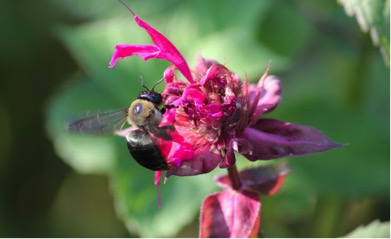
Xylocopa virginica on bee balm (Monarda) in late summer

Xylocopa virginica on bee balm (Monarda) in late summer

My favourite social bee is generally the one that I am writing a paper on, which at the moment is the Eastern Carpenter Bee, Xylocopa virginica. The more we study this bee, the more complex and interesting its social behaviour gets, which is mildly ironic, because recently a reviewer suggested that despite complicated behavioural interactions among co-nesting females, these carpenter bees are not “truly social”. The still rather widespread presumption that caste-based eusociality is the only “true” form of sociality certainly influences how we think about social evolution in insects. [1] The recent publication in Insectes Sociaux of a paper entitled “Casteless sociality in an allodapine bee and evolutionary losses of social hierarchies” by da Silva, Stevens and Schwarz (2015), provides a timely reminder of the enormous breadth of social behaviour in bees, which includes both caste-based and casteless forms.

Allodapine bees are the best studied of four tribes in the carpenter bee clade (Xylocopinae), thanks to years of research by Mike Schwarz and his colleagues at Flinders University in Australia.   Allodapine bees exhibit several distinctive characteristics, including progressive provisioning of their offspring, which are raised in chambers excavated in plant stalks and branches. They also exhibit a wide range of colony types, from mostly subsocial species to eusocial, including a highly eusocial species whose morphologically distinct castes represent an independent transition to this form of obligate eusociality (Dew et al., 2012). Da Silva and colleagues studied Braunsapis puangensis nesting at several locations in Fiji (!), collecting nests and examining their contents. These bees live in small groups of up to five females, with the modal group size being one, suggesting that females can nest either solitarily or socially. By comparing the number of brood in a nest to the number of adult females, da Silva et al. estimated the per capita rate of brood production in nests with differing numbers of females. Two main trends emerged. First, social nests almost invariably contain brood whereas solitary nests often do not. This is consistent with a general pattern in allodapine bees in which sociality protects against total brood loss. Second, in social nests with brood, the main predictor of per capita brood productivity was the length of the nest cavity, with per capita brood productivity declining as group size increased. This is a surprising conclusion because in previous studies of allodapines, Schwarz’s group has found a positive relationship between group size and per capita productivity. The study thus provides “a clear benefit to social nesting in terms of preventing brood loss”, but no advantage (indeed, a detriment) when group size increases above two females.

Braunsapis puangensis, under the microscope (photo courtesy of Mike Schwarz).

Braunsapis puangensis, under the microscope (photo courtesy of Mike Schwarz).

Perhaps the most interesting finding in this paper is that referred to in the title: multi-female groups comprise casteless societies. In most social insects, the familiar queen and worker castes exhibit a negative association between reproduction and work. An idiosyncracy of social carpenter bees is that the reproductive castes can be based on a positive association between reproduction and work (Hogendoorn and Velthuis, 1999). However, in Braunsapis puangensis, there is no evidence of either type of caste division – co-nesting females are no more different in wing wear (which measures foraging activity) and ovarian development (which measures reproductive potential) than randomly selected pairs of solitary females. Although Schwarz’s group prefer the term “casteless sociality”, the more traditional term “communal” would also appear to be an apt descriptor of colony social organization in B. puangensis. Phylogenetically, B. puangensis seems to represent an evolutionary transition from a hierarchical, caste-based form of sociality to an egalitarian, casteless form of sociality. Although it was once predicted that communal and eusocial behaviour were mutually exclusive and not to be found in the same clade, but it would appear that B. puangensis provides us with a rare piece of evidence refuting this hypothesis.
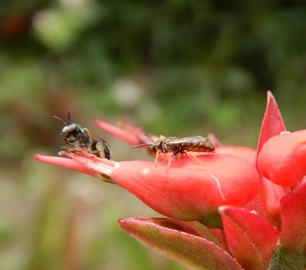
Braunsapis puangensis (L) conferring with Homalictus (R), about the evolution of casteless societies in bees (photo courtesy of Mike Schwarz).

Braunsapis puangensis (L) conferring with Homalictus (R), about the evolution of casteless societies in bees (photo courtesy of Mike Schwarz).

How rare is communal behaviour in bees, and is the almost complete absence of communal behaviour in eusocial lineages real? It’s difficult to tell, because current approaches emphasize caste-biased sociality, relegating other forms to the “not truly social” category. For instance, in a recent phylogenetic study investigating evolutionary transitions between solitary and social behaviour in halictine bees, communal species were classified as solitary while species with caste-based societies were classified as social (Gibbs et al., 2012). [2] In another recent contribution to Insectes Sociaux, Dew, Tierney and Schwarz (2015) emphasize that our ability to identify egalitarian, casteless societies in bees depends on how we define communal, egalitarian behaviour and the observational methods used to distinguish it from hierarchical forms of colony social organization. I would not be surprised to find out that in bees, at least, casteless and other types of non-eusocial societies, are a lot more common than we currently think.

Author’s footnotes:

[1] Of course, I disagreed with the reviewer and included the word “social” in the title – not once, but twice! (Richards, 2011)

[2] Some of the authors of this paper have been forced to endure considerable haranguing from me about behavioural differences between solitary and communal bees, which they did with great good humour.

References

da Silva, C.R.B., Stevens, M.I., and Schwarz, M.P. 2015. Casteless sociality in an allodapine bee and evolutionary losses of social hierarchies. Insectes Soc. http://link.springer.com/10.1007/s00040-015-0436-0

Dew, R.M., Rehan, S.M., Tierney, S.M., Chenoweth, L.B., and Schwarz, M.P. 2012. A single origin of large colony size in allodapine bees suggests a threshold event among 50 million years of evolutionary tinkering. Insectes Soc. 59: 207–214

Dew, R.M., Tierney, S.M., and Schwarz, M.P. 2015. Social evolution and casteless societies: needs for new terminology and a new evolutionary focus. Insectes Soc.

Gibbs, J., Brady, S.G., Kanda, K., and Danforth, B.N. 2012. Phylogeny of halictine bees supports a shared origin of eusociality for Halictus and Lasioglossum (Apoidea: Anthophila: Halictidae). Mol. Phylogenet. Evol. 65: 926–939

Hogendoorn, K., and Velthuis, H.H.W. 1999. Task allocation and reproductive skew in social mass provisioning carpenter bees in relation to age and size. Insectes Soc. 46: 198–207

Richards, M.H. 2011. Colony social organisation and alternative social strategies in the eastern carpenter bee, Xylocopa virginica. J. Insect Behav. 24: 399–411

da Silva, C.R.B., Stevens, M.I., and Schwarz, M.P. 2015. Casteless sociality in an allodapine bee and evolutionary losses of social hierarchies. Insectes Soc.
Interview with a social insect scientist: Boris Baer

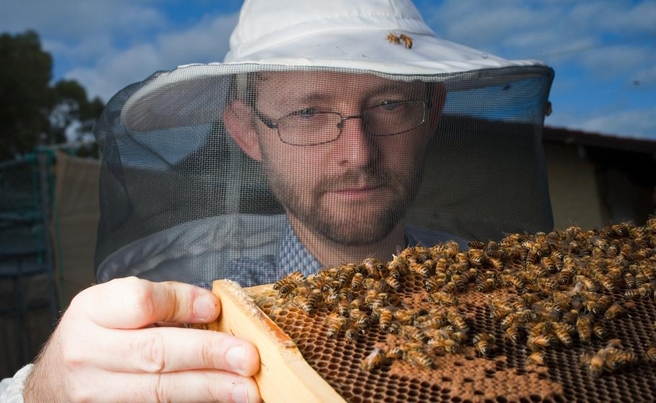
Curtin University Centre for Integrative Bee Research director Dr Boris Baer is concerned about bee biosecurity in Albany and Denmark. Picture: UWA

IS: Who are you and what do you do?

BB: I am a researcher at the Centre for Integrative Bee Research (CIBER) at the University of Western Australia using honey bees and leaf cutting ants as my preferred research pets. I was trained as a classical behavioural ecologist but now try to use tools from systems biology such as proteomics to understand how life history traits related to reproduction or immunity are determined through the complex interactions of protein and metabolite networks.

IS: How did you end up researching social insects?

BB: I always had a crush for insects, but regarded that more as a hobby while doing research on “real animals”. In my case that was a small monkey that I chased through South American rainforests as part of my Honours thesis. As I had spectacularly little success with the monkeys, I became increasingly drawn to social insects, especially after I saw the amazing diversity of orchid- and stingless bees, and my first encounters with fully grown colonies of army- and leaf-cutter ants.

IS: What is your favourite social insect and why?

P1000826BB: I don’t have a specific species that I would call my preferred pet. The most amazing thing for me is not so much that these insects are social, but the amazing variation we see between species. Having said this, bees just give me a tiny little extra kick.

IS: What is the best moment/discovery in your research so far? What made it so memorable?

BB: I conducted the field research of my Honours thesis on a field station in French Guiana, located a two-day trip by car, boat and foot away from the next human settlement in the jungle. To observe our study animals in their habitat, we installed ropes and wooden platforms into some of these giant rainforest trees. Climbing up there into the canopy for the first time a good 30+ meters gave me the ultimate kick. Hanging on a small rope 30 meters above ground was the scariest thing in my life and turned me into an endorphin junky. However, sitting up there and seeing this carpet of green, completely unspoiled rainforest to the horizon was a key event that lead me to continue a career in science.

IS: If teaching is part of your work, what courses do you teach? Has your work on social insects helped to shape your teaching?

BB: I am teaching in Biology and Agriculture. Using social insects for my research makes teaching so much easier, because it is easy to get students interested in a topic.

IS: What is the last book you read? Would you recommend it? Why or why not?

BB: The Beekeeper’s Pupil by Sara George, which might read a bit nerdy, because it is a book about honeybees. The book is based on a true story, that took place in the 17th century and describes the research that revealed the first insights into the life history of honey bees and their sex life. The most fascinating bit of the book is that the main character of the book doing the research is blind. He therefore needed to train a man servant to do the practical work and describes his observations to him. It is therefore not only a book about bees, but also about science and how to progress it.

IS: Did any one book have a major influence in shaping your career? What was the book and how did it affect you?

BB: I was still a boy when I got the book Man Meets Dog by Konrad Lorenz. I was instantly fascinated by animal behaviour and as it was the high days of Ethology, I decided to become an ethologist. This had interesting side effects as I turned our dog into a scientific experiment and my parents had to protect the poor creature every now and then from being overused as a laboratory animal.

IS: Outside of science, what are your favourite activities, hobbies or sports?

BB: I like to go sailing, which is a wonderful opportunity to get unplugged from work. The boats used can easily tip over in high winds so I need to concentrate on the wind and water, so it is also a perfect way to escape daily life.

IS: If you were on an island and could only bring three things, what would you bring? Why?

BB: A tent, a magnifying glass and my wife. The tent is obvious; the magnifying glass is good to have a look around and apparently also gets a fire going. Based on my life experience so far, I see the presence of my wife as the best warrant to keep me alive.

IS: How do you keep going when things get tough?

BB: This must be clear by now from my answers above: First go sailing and if that does not help go and have a whinge* chat with my wife.

*IS note: in Australian English, ‘whinge’ means to whine or complain.

IS: Who do you think has had the greatest influence on your science career?

BB: My grandmother. She was fascinated by the natural sciences and her flat was something between a science library and a museum. She had a large collection of books on geology, astronomy or biology but her shelves also displayed all sorts of things such as rocks and bones, including a telescope that we used during summer nights to look at Mars. If she would have been born in modern times, there is no doubt that she would have become a scientist, but as a girls born 1901 into a family of bankers, there was no way for her to pursue such a career. I guess her way deal with this was to get her grandchildren fascinated in science. It worked.

IS: What advice would you give to a young person hoping to be a social insect researcher in the future?

BB: There is still so much we don’t know about these animals and we have so breathtakingly new methods and technologies available now to study and understand them, so if you have the slightest interest, then go for it! Unfortunately, we also live in a time where scientists need to constantly justify their existence and performance. My advice is to not let paper numbers, impact factors and key performance indicators dictate your career. Play that game but use the remaining academic freedom you have left to explore where your interests are and don’t be afraid to pursue the impossible.

Interview with a social insect scientist: Terry McGlynn

Hi everyone. Here at the Insectes Sociaux blog our aim is to get behind the cool research and share the human element of the research with you as well. We have begun to interview social insect scientists as part of this effort. Our first interviewee is Terry McGlynn. We hope you enjoy this interview as much as we did. – MP

Terry McGlynn

IS: Who are you and what do you do?

TM: I’m Terry McGlynn, and I work on the experimental natural history of rainforest ants. I’m a parent and a spouse. I also teach, mostly with students from backgrounds underrepresented in the sciences.

IS: How did you end up researching social insects?

TM: You know how some kids just love to play with bugs and never grow out of it? That’s not me. Of course, ants are amazing, but I didn’t really appreciate that when I was younger. I had a great class in Insect Biology in college, and when I realized I was into the evolution of behaviour, I gravitated towards ants.

IS: What is your favourite social insect and why?

TM: Gypsy ants, Aphaenogaster araneoides. If you watch them move about, they’re just the most charming creatures. They also have a very curious behaviour – their gypsy habit — that has been a side project for the last fifteen years. They remain a puzzle that I wish to solve. I love that they keep me guessing.

IS: What is the best moment/discovery in your research so far? What made it so memorable?

TM: I do my best to savor the little moments. For example, I couple years ago, I stopped what I was doing to watch a leafcutter foundress (Atta cephalotes) excavate a brand new nest. The odds against her were extraordinary, of course. But, to observe the modest beginnings of what may become a monumental endeavour was a good lesson. I watched her for 45 minutes. Depending on your perspective, that duration could be a flash or it could be an eternity.

As for a research discovery, those almost always happen at the computer, when I’m going through results! The most recent exciting one that comes to mind was when I discovered a very simple predictor of caste ratio in Pheidole. You’d think that something as simple as body size couldn’t predict caste investment throughout the whole genus globally. Discovering a new and simple generalized pattern is exciting, mostly because it teases entirely new avenues.

IS: If teaching is part of your work, what courses do you teach? Has your work on social insects helped to shape your teaching?

TM: Teaching is a huge part of my work – my employer is definitely more focused on teaching than research. In the past year, I’ve taught biostatistics, and run classes supporting K-12 science teachers. I also have joined others to teach the Ants of the Southwest field course in Arizona, focused on the integrative biology of ants. Come to think of it, I do think that thinking about the relationship between cooperation and conflict in social groups of ants has helped me think about how my classes run. Effective teaching requires opportunities to cooperate, and respectful relationships with students minimize conflict.

IS: What is the last book you read? Would you recommend it? Why or why not?

TM: I just read Eyrie, the latest novel by Tim Winton. It was good, but I’d recommend other ones from him first (The Riders, Cloudstreet or Dirt Music). Science-wise, I recently finished Harry Greene’s memoir, Tracks and Shadows. If you want to know how you can build a career that emphasizes natural history and basic discovery, then Harry Greene explains how he did it. I don’t think what he did can work for most of us, but it’s still a good story.

IS: Did any one book have a major influence in shaping your career? What was the book and how did it affect you?

TM: I have no choice but to point to Hölldolber and Wilson’s The Ants. It was relatively new when I started grad school, and it was the authoritative tome. Of course the massive amounts of information affected how I thought about ants in so many ways. More important, however, the fact of the book itself affected me. It just floored me, that notion two people could fall in love with ants so much that they would go to the trouble to create such a thorough and gorgeous product in homage of their beauty. That book is a tangible manifestation of academic passion.

IS: Outside of science, what are your favourite activities, hobbies or sports?

TM: I like to hike in beautiful places, read literary fiction, travel to new places, visit museums, and I’ve started running months ago. A silly hobby involves the official Historical Landmarks the state of California — there’s about 1,000 of them. When I come upon one, I make sure to get a picture of the historic plaque. I might go out of my way a little bit for one if I have the time. I’ve probably visited a couple hundred by now.

IS: How do you keep going when things get tough?

TM: I don’t know. I just keep going. And I have been through tough times, career-wise. It helps to make sure that you continue to sleep enough, eat well, and keep moving. Physical inactivity amplifies stress. The support of people who care is important.

IS: If you were on an island and could only bring three things, what would you bring? Why?

TM: I’d need to be able to read and to write. So, I guess, a really good book, a computer, and maybe a coffee press? Because coffee.

IS: Who do you think has had the greatest influence on your science career?

Ant research

TM: My undergrad advisor, Beth Braker. Even though I was a middling student in several dimensions, she invested concern in me. Because of her, I ended up working on insects in the tropics, and she remains a valuable mentor and friend to date. She’s been a remarkable model as an academic parent as well. She provides an exemplary counterbalance to the tragically pervasive notion that undergraduates are less important than other scientists.

IS: What advice would you give to a young person hoping to be a social insect researcher in the future?

TM: We don’t even understand what causes gravity, much less understand what happens within and among social insect colonies. Organisms and biological communities are far more complex than gravity. If a mystery is worth solving to you, then I think it is worth solving. If you’re excited by it, that’s enough. That said, the pursuit of mystery is secondary to health, happiness, and employment.

Getting to know an ant colony from the underground up

Highlighting the article by Murdock and Tschinkel in the August 2015 issue of Insectes Sociaux

Written by Walter Tschinkel

Once you accept that an ant colony is an organism-like entity, that it is a superorganism shaped by natural selection, the question of how to characterize the colony changes radically. Thinking of the colony as an organism in and of itself changes the focus from the individual workers, brood and queen to a focus on colony-level attributes. Neither the cells of an organism, nor the workers of a superorganism have a reproductive future save through helping the entity of which they are a part reproduce more of that entity. We tend to be blind to the superorganismal nature of ant colonies, perhaps in part because, unlike the cells of an organism, the ants are not physically attached to one another, but rush about performing their daily, colony-benefitting tasks. Natural selection hones the behaviour of individual ants, creating a more effective division of labor (function), which optimizes the survival, and reproduction of the superorganism (colony).

To continue the parallels, both organisms and superorganisms are the outcome of development (embryogenesis and sociogenesis, respectively). The ant superorganism develops from a single queen (in most cases), has a growth rate, a lifespan and a maximum size. It builds a nest of a characteristic size and depth. Once large enough, it begins to reproduce through the emission of sexual ants on mating flights. Its workers have a characteristic size, number, turnover rate, and division of labor, along with many other details of form and function. The queen has a characteristic size, lifespan and reproductive rate. On top of all this, the superorganism goes through a seasonal cycle driven ultimately by the climate. All of these are the evolved characteristics that we need to measure in order to understand the superorganism and how it works.

In order to determine colony-level traits, entire colonies must be collected and analyzed, together with their nest architecture (referred to as sociometry). As colonies grow and behave differently throughout the seasons, they must be collected at every stage of their lifetime development and in every significant season. But how do you capture an entire colony of ants and preserve its nest architecture at the same time? In a previous study (2010), we showed that paraffin wax casting of nests accomplished this goal- stopping entire ant colonies in their tracks and revealing their structure, much like the historic volcanic eruption did in the city of Pompeii.

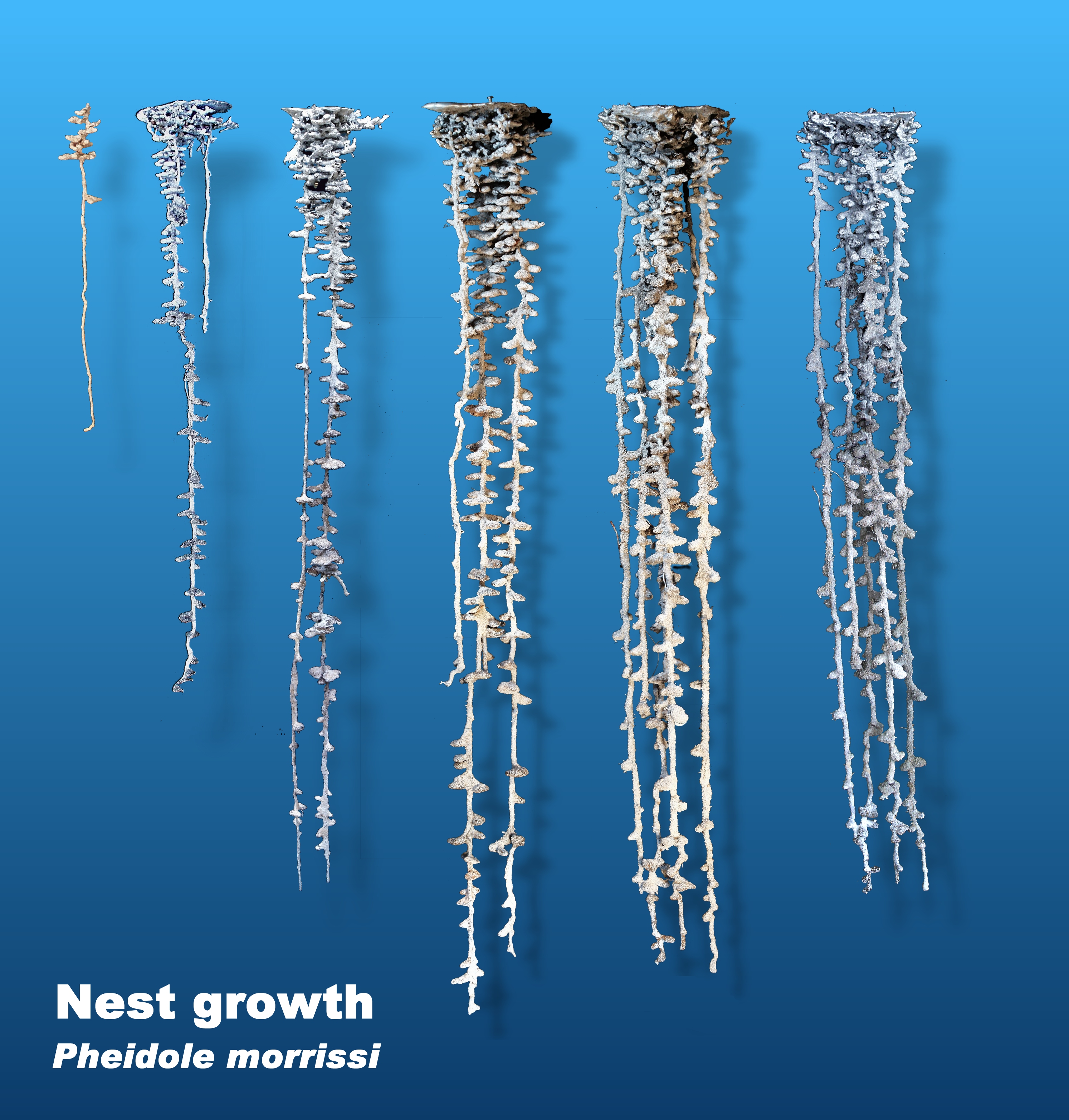
An example of a reconstructed P. morrisi nest cast.

An example of a reconstructed P. morrisi nest cast.

The method is simple. In our study, we melted paraffin wax in a coffee pot, then exposed the openings of the P. morrisi nest and poured molten wax into it until the nest was full. The wax flowed into every nook, cranny and chamber of the nest, capturing everything in place, leaving a hardened cast of a perfect, three-dimensional, quantitative record of the colony in space.

Perhaps acting more like archaeologists than entomologists, we collected the cast by digging a pit next to it, and removing the cast from the side in 10 cm increments. Back in the lab, we melted these increments in an oven, filtered out the ants and other contents and cleaned them with solvent. The workers, queens, larvae, pupae and any ant guests were then counted, measured and otherwise studied. It took a lot of time, but we know of no better method for getting such complete information about a superorganism.

In our current paper (Murdock and Tschinkel 2015) in this issue of Insectes Sociaux we used this method on a larger scale to determine the development and seasonality of colonies of the common ant, Pheidole morrisi in the flatwoods of northern Florida.

P. morrisi ants.

P. morrisi ants.

Our goal was to determine how colony composition changes as colonies grow and go through the seasonal cycle. To capture this information, complete colonies of the full range of sizes were sampled on several dates that represented important phases in the annual cycle. The data were then analyzed on two interacting axes— colony size and season— to reveal P. morrisi‘s suite of evolved adaptations that make it what it is. With this example, we hope to stimulate similar studies on many ant species, eventually revealing how ant colonies of different lifestyles evolve in different habitats and latitudes.

So what were the findings? Colonies contained up to 49,000 ants, much larger than previous estimates of maximum size. With respect to the seasonal pattern of brood production, colonies of all sizes did the same thing- they increased brood production at the same point in the season, emphasizing that these seasonal patterns are a basic adaptation. Colonies overwintered larvae but no pupae, so that broad cohorts within the colony were, in turn, larvae, pupae and very young workers. Consequently, workers in each age group lagged each other by approximately a season from winter until late summer. In the warmer months, there were two periods of worker larva production separated by early summer sexual production. Colonies as small as 3000 workers were able to produce sexuals. Surprisingly, larger colonies did not produce more sexuals than the smaller colonies, and the number was low even for very large colonies.

This study is one of the few that links the nest architecture to the colony residing within, revealing a complex dance in which the ants and their brood move up and down during the annual cycle in nests whose maximum depth ranged from 0.5 to 2m. It seems likely that the vertical arrangement is in response to social, rather than physical factors such as temperature. Brood and callow workers almost always occur together, and brood care is the first duty of young workers. Generally, the colony moves into the deeper parts of the nest in the winter, and upward in the spring, coming to reside in the upper third or so of the nest. By late summer, downward movement has begun and by fall, part of the colony is deep in the nest and part higher. Interestingly, in the winter, major workers predominate in the bottom of the nest, with minors more evenly distributed, but in the spring and early summer, majors move up, suggesting a special function associated with the activities of that season. Because the major workers live longer, their proportion of total colony weight increased during the year, reaching almost 40% by fall, and this pattern was the same for colonies of all sizes. Temperatures ranged from 12 to 17o C in the winter to 23–33o C in late summer. Brood was mostly found in the warmest regions of the nest.

A figure illustrating P. morrisi nest growth from left to right.

A figure illustrating P. morrisi nest growth from left to right.

The nests were top-heavy in that volume decreased strongly with depth, so that no matter what the absolute nest size, about half of the available space was in the top 20% of the nest. However, the vertical distribution of the ants is not in response to the space available. The seasonal movement from deep to shallow and back down resulted in extreme seasonal changes in crowding at changing depths, but the importance of crowding in ants is not understood.

Other, less obvious measures can also be derived from such data. Among the most important is the worker birth rate in relation to season and colony size. In ant colonies, workers are continually dying and being replaced, in other words, turned over (like cells in the body). The maximum colony size is thus achieved when worker birth rate equals worker death rate. A crude estimate of birth rate can be made from the number of pupae. For example, if a colony census shows 1000 pupae, and the pupal period lasts 10 days, then an average of 100 new workers will be born per day. Given additional information, such data can produce seasonal and size-related estimates of colony growth rates.

This study confirms that a sociometric/sociogenic study based on wax casting is very doable, and can efficiently reveal many features of the life and seasonal cycle of an ant species. Because the colony is the counterpart of the unitary organism, the resulting description of the species P. morrisi tells us who this ant really is and how it is distinguished from others.

About the author: Walter Tschinkel is a Robert O. Lawton Distinguished Research Professor of Biological Science at Florida State University in the U.S.A. He can be reached by email at tschinkel@bio.fsu.edu

A newly recognised eusocial bee

Highlighting the article by Dalmazzo and Roig-Alsina in the May 2015 issue of Insectes Sociaux

Written by Michael Breed, Editor-in-Chief, Insectes Sociaux

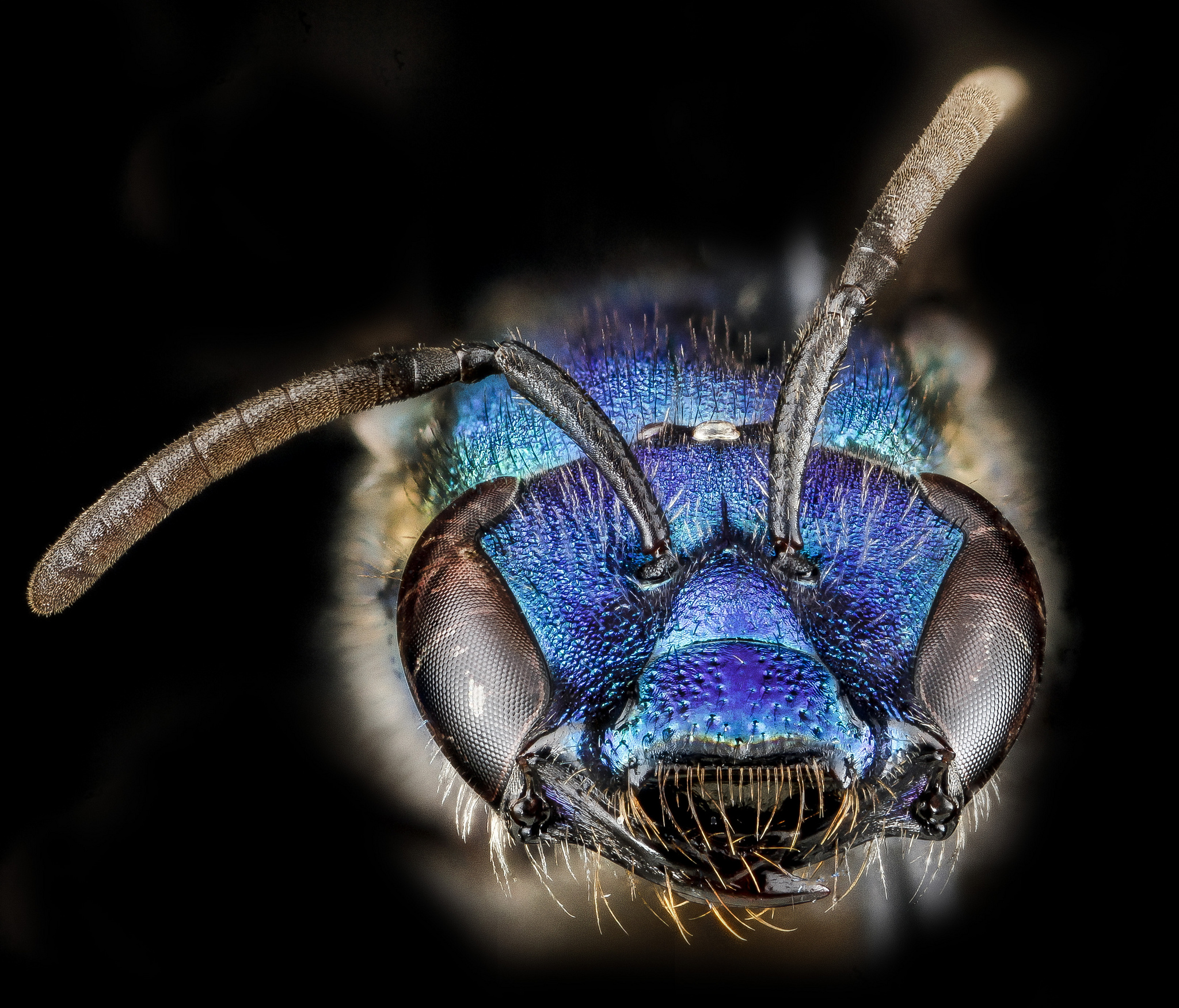
An Augochlora species, A. regina.

An example of an Augochlora species, A. regina. Photo from Flickr: USGS Bee Inventory and Monitoring Lab. https://www.flickr.com/photos/usgsbiml/

The bee family, Halictidae, gives us a fascinating diversity of social behavior, presenting species across the spectrum of sociality. Halictids can strictly be solitary, communal or eusocial, but some species have the ability to adjust their level of sociality in an adaptive manner. The halictids show at least three independent origins of eusociality, as well as many reversions from eusocial to solitary behavior.

With over 4000 species worldwide, these small bees, which range in color from green to black and in tone from dull to metallic, may be our best window into the evolution of behavior at the beginning stages of eusociality. Excavations of soil nesting species followed by lab rearing have given great insight into social evolution. However, the social biology of less than 1% of halictid species is known, and studies of additional species are of great value for our understanding of social evolution.

In this issue, Dalmazzo and Roig-Alsina (2015) report eusocial behavior in Augochlora phoemonoe. The halictid tribe Augochlorini is rich in flashy metallic green species and most species is rich in the new world tropics. The social behavior of augochlorines is understudied relative to the more temperately distributed Halictini. Brady et al. (2006) show that eusociality evolved independently in the Augochlorini, distinct from two separate derivations in the Halictini.

Dalmazzo and Roig-Alsina collected female A. phoemonoe in the region of Buenos Aires, Argentina. This species nests in decaying wood and they were able to establish queens in artificial nests using long-established laboratory techniques for fostering halictids.

First, and perhaps most important in supporting an argument for eusociality, the investigators found that A. phoemonoe raised in the laboratory display a seasonal life cycle, with nest establishment by solitary queens, a first brood cycle of female workers, and then, a second brood cycle that produces the next reproductive generation of gynes and males.

Division of tasks among workers within colonies often co-occurs with the reproductive division of labor characteristic of eusociality. Dalmazzo and Roig-Alsina documented locomotion, feeding, construction, pollen collection, guarding and egg-laying activity of colony members. Not surprisingly, oviposition was a rare event and only queens were observed laying eggs. Daughters of the foundress engaged in much more construction, pollen collection and guarding than did their mothers. The mothers, however, initiated most social interactions with their daughters. These observations follow the same general pattern of structure of social behavior found in other eusocial halictids.

Among the key questions that remain for this species include the range of social behavior that might be observed in field populations. In particular, colonies of some other species of halictid lose their queen in the early or mid-stages of the colony cycle. One of her daughters then takes on the role of reproduction in the colony, and the resulting social structure is termed semisocial. Semisociality is potentially important because its presence or absence may reflect the impacts of selection on queen longevity. Queen survivorship in field conditions is a critical issue for future investigation.

This study provides intriguing information that builds our comparative base for comprehending social evolution in bees, and by extension in all animals. It illustrates the value of continuing to expand, species by species, the evidence for sociality.

A quest for mate recognition cues in an Indian paper wasp

Highlighting the article by Mitra et al. in the May 2015 issue of Insectes Sociaux

Written by Aniruddha Mitra

Mate recognition is a vital aspect of communication, essential for survival of the species, as in nature males and females have to find each other and recognize the sex of the partner before engaging in reproduction related behaviors and mating. Sensing chemicals form a major part of the sensory world of insects, and chemical signals (pheromones) released by an individual are perceived by others, following which, the kind of signal received alters the behavior and decision making of the receiver.

Chemical signals called sex pheromones play an important role in attracting mates, sex recognition and mating related behaviors in the majority of insects. In many insects, sex pheromones are volatile chemicals that serve to attract mates from a distance. In some insects non-volatile chemicals like hydrocarbons present on the body surface have been implicated as sex pheromones. The external body surface (cuticle) of insects is covered by a waxy layer of hydrocarbons, which primarily serves to provide protection from dessication and pathogens. However in some insects, especially the social Hymenoptera (ants, social wasps and social bees), the cuticular hydrocarbons (CHCs) also play a role in communication.

CHCs can provide several types of information about an individual ant, bee or wasp. Variations in the composition of CHCs, allow workers to identify their queen, distinguish members of their own nest from those of other nests as well as obtain other forms of information about an individual. CHCs may also function as sex pheromones, and differences in CHC profiles of males and females (sexual dimorphism in CHCs) have been discovered in diverse groups of insects (more than 100 species from 7 different orders).

The social hymenopteran insects have been the focus of numerous studies of CHCs and their role in communication. However, few studies have looked at sexual dimorphism of CHCs or role of CHCs in mate recognition in social hymenopterans. Also sex pheromones (including CHCs as well as other volatile chemicals) remain a relatively less known area in the biology of Hymenoptera. Hence to generate more knowledge in this area, we investigated the question of whether sexual dimorphism of CHCs exists in our study species, a social wasp from southern India. We also tried to detect potential volatile cues that may attract mates from a distance.

The wasp Ropalidia marginata has been studied over more than two decades, and only in the last 5 years have we uncovered aspects of chemical communication in this species. We have discovered that the queen signals her presence to workers through a gland secretion and that through CHCs, workers can differentiate their own nest members from members of other nests. In our work detailed in Insectes Sociaux, we investigated another aspect of possible chemical communication in this species – mate recognition through chemical cues.

Fig. 1: Male (left) and female (right) R. marginata wasps.

Fig. 1: Male (left) and female (right) R. marginata wasps.

R. marginata wasps live in colonies comprising of a queen and several workers and build nests of paper from cellulose from plants. There is no seasonal variation in colony cycle, and all females can mate and have the potential to become a queen. Males stay on the nest for about a week and then leave the colony to live a solitary nomadic life. Mating is believed to occur on trees and other areas where females go out to collect food and building material, and has never been seen on the nest. Before mating, males approach females and touch them with their antennae, following which the male mounts the female and grasps her antennae with his antennae, finally culminating in mating.

Since the male and female touch each other with their antennae before mating, we looked for any non-volatile cue that may be present on the cuticle and be perceived by touching with antennae. We analyzed the chemical composition of non-volatile CHCs by gas chromatography (see Fig. 2). For a CHC to act as sex pheromone, there should be some consistent difference between the CHC profiles of males and females, otherwise the wasps would not be able to differentiate between the two. We did not find any significant differences in CHC composition between males and females, therefore we ruled out the involvement of any non-volatile CHC as a mate recognition cue.

FIg. 2: A representation of the gas chromatography (GC) device that detects the chemical components present in the CHCs of male and female wasps. We found no significant differences in the CHC chemical profiles between male and female wasps.

FIg. 2: A representation of the gas chromatography (GC) device that detects the chemical components present in the CHCs of male and female wasps. We found no significant differences in the CHC chemical profiles between male and female wasps.

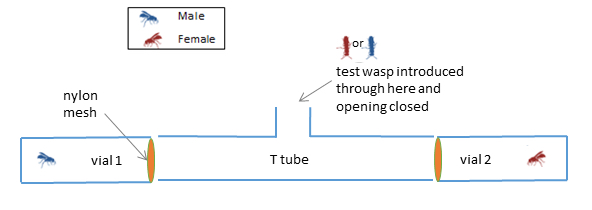
Next, we explored the possibility that there are volatile cues that may act as sex attractants. We then further analysed the CHCs in order to detect chemicals that may be volatile. This analysis showed that volatile chemicals are absent in the CHCs. Finally we did a behavioral assay to see if males and females are attracted towards each other from a distance. By doing this, we could test for any volatile compound from the cuticle that may have been missed in the chemical analysis, and would also cover volatile cues from sources other than CHCs. Wasps were introduced at the center of a T-tube maze (see Fig. 3), and a female and a male were kept at either end of the T-tube (separated from the test wasp by a mesh). We found that males did not spend more time towards the side of the T-tube containing a female, compared to the side that had a male. The same held true for females, who did not spend more time towards the male side, compared to the female side. Thus we failed to find evidence of any volatile cues that may attract members of the opposite sex towards each other.

Fig. 3: A representation of the T-tube choice apparatus used to test whether female and male wasps are attracted to a member of the opposite sex that they can smell, but cannot see. Neither female nor male wasps showed a preference for either the same or the opposite sex.

Fig. 3: A representation of the T-tube choice apparatus used to test whether female and male wasps are attracted to a member of the opposite sex that they can smell, but cannot see. Neither female nor male wasps showed a preference for either the same or the opposite sex.

It remains unclear whether any sex pheromone exists in this species. In Hymenoptera, apart from CHCs, sex pheromones have been reported from various glands, so it is possible that some glandular secretion that is released after the male and female come in contact with each other plays a role in mate recognition. Compounds other than hydrocarbons like peptides and proteins are also reported to be present on the cuticle, and these may have a role in mate attraction. Finally it may also be possible that mate recognition in this species does not involve chemical cues and involves visual cues instead. Some social wasps have the ability to recognize faces (see, for example, here) and since the face of males is yellow, while those of females is brown (see Fig. 1), it is possible that they might use this visual cue to recognize members of the opposite sex, but we still need to search for the answer to how male and female R. marginata manage to find and recognize each other in a large and complex environments.

About the author: Aniruddha Mitra is a researcher at Laboratoire Evolution, Génomes, Comportement, Ecologie, CNRS, Gif sur Yvette, France. He can be reached by email at mitra.aniruddha@gmail.com.

Joining the conversation: Social media and Insectes Sociaux

Editorial

Insectes Sociaux now has a strategy for engaging the IUSSI community of scholar/scientists in a faster-paced and less formal mode of scientific conversation. Through our Facebook page, Twitter feed @InsSociaux, and blog, we aim to bring life to the often difficult to penetrate world of scientific publication and to connect our community in a new and dynamic way.

Follow us on Facebook and Twitter to receive news and updates on Insectes Sociaux. Subscribe to the blog, which features essays by Insectes Sociaux editors and authors! Coming attractions may include Instagram, a YouTube channel, and whatever new and exciting developments in social media become available. Facebook and Twitter help to create a sense of immediacy about articles in the journal, as well as providing access to colleagues who can meet, potentially share expertise, and maybe even assist with the occasional species ID.

Traditional scientific publication forms an extended and very slow-paced conversation. The segments of the conversation include citations of older publications, the interchange among authors, editors and reviewers during the publication process. Readers react to a publication, and ultimately may join the conversation by continuing the cycle by publishing work that adds another layer of citations to the conversation. The traditional conversation has tremendous advantages in providing a filtering system, via editors and reviewers, for quality-checking work prior to publication.

The traditional system also has enormous disadvantages in favoring a writing style that is compact, unexpressive of emotion, and very restrained. This means that an author’s passion for their work is left unexpressed. Opinions about interpretations are typically self-suppressed because they are likely to incite negative reviews. Sometimes—perhaps often!— jargon and cryptic writing cloak the significance of piece of scientific work so that it is only apparent to a small circle of colleagues who possess very specific expertise related to the topic of the article.

The blog gives authors and editors an opportunity to express their passion for their work in less formal terms. We can try to write clearly, to explain the history behind their scientific choices, and to articulate opinions about findings. We can argue for the significance of a piece of work and why the community should pay attention to that work. In other words, we add an element of excitement to the framework of our journal. By presenting our work in this way, we also make it accessible to wider audiences, who can (potentially) get as excited about our work as we do!

Our honest intent is to elevate Insectes Sociaux in the collective mind of our community so that we remain an important outlet for scientific publication. By providing immediacy, non-traditional outlets for expression, and a conversation that extends beyond the pages of the journal we hope to bolster the significance of Insectes Sociaux.

Michael Breed, Editor-in-Chief

Marianne Peso, Social Media Editor

Ants in flight

Highlighting the article by Helms and Kaspari in the May 2015 issue of Insectes Sociaux

Written by Jackson A. Helms IV

When most people think of ants they probably picture a colony of wingless workers. Seen this way, it is easy to forget that ants are really just an odd family of wasps. Most ant queens, on the other hand, are indeed wasp-like, possessing wings and the ability to fly.

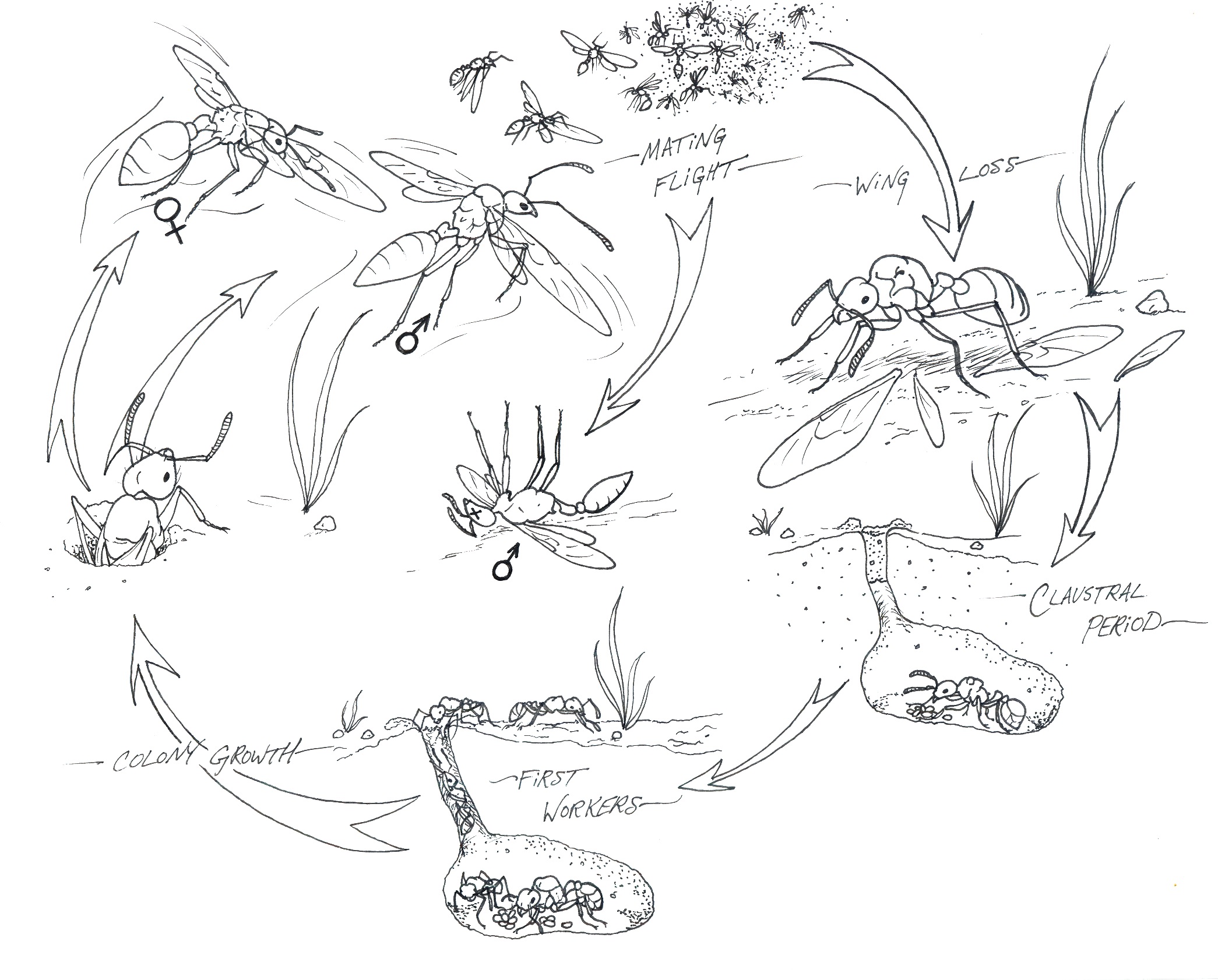
After maturation, virgin queens leave their birth nests and fly out into the world to mate, find a place to live, and start their own colonies. These aerial explorers—the mothers of the ant world—fascinate me. While most ant enthusiasts spend their time looking down at what worker ants do on the Earth’s surface, I spend my time looking up at what their elusive queens do in the atmosphere.

Ant life cycles are complicated and varied, but in almost all species the queens have wings and fly through the atmosphere to mate and find new places to live (drawing by Brittany Benson)

Ant life cycles are complicated and varied, but in almost all species the queens have wings and fly through the atmosphere to mate and find new places to live (drawing by Brittany Benson)

In our most recent paper, just out in Insectes Sociaux, my coauthor and I take a comprehensive look at queens from across the ant family to answer some questions about ant flight. How well do different species fly? Does flight vary depending on whether a queen hunts, farms, or acts as a social parasite that invades the nests of other species? How and why do some ant species lose the ability to fly?

Dolichoderus laminatus queens fly through rainforest canopies and found new colonies inside the nests of tree-dwelling termites (photo by Jackson Helms)

Dolichoderus laminatus queens fly through rainforest canopies and found new colonies inside the nests of tree-dwelling termites (photo by Jackson Helms)

To investigate these questions we compared queens of twenty-one ant species from Panama, ranging from the tiny Pheidole christopherseni (weighing in at less than a third of a milligram) to the grape-sized leafcutter ant Atta colombica (about 700 times as heavy). First we captured the queens on their mating flights using light traps hung in the forest. We then dissected them and examined their wings, flight muscles and abdomens to get some insight into how they fly based on their body size and shape.

As part of our analysis we measured all the queens’ wings, from the giant wings of Atta leafcutters (left) to the tiny feathery wings of Hypoponera huntress ants (right) (photos by Jackson Helms)

As part of our analysis we measured all the queens’ wings, from the giant wings of Atta leafcutters (left) to the tiny feathery wings of Hypoponera huntress ants (right) (photos by Jackson Helms)

We find that just as there is seemingly infinite variation in ant morphology, physiology and behaviour, (over 12,000 known species and counting), each species likewise varies in how it flies. Based on our analyses of the 21 species we collected in Panama, we found that tiny species are nimble flyers and able to stay aloft for a long time, while large species fly faster. Queens from the subfamily Ponerinae (which are primarily hunting species), have agile athletic bodies and large flight muscles, making them decent all-around flyers. Soft-bodied tree-dwelling ants (subfamily Dolichoderinae) appear to have short, fast flights—probably just long enough to find a suitable hollow branch or snag to settle in. Socially parasitic queens, who take over or make their homes inside other ant or termite nests, can probably fly longer and farther than queens who go through the trouble of starting a colony from scratch. Leafcutter ant queens, who plant and tend fungus gardens, likely get a similar boost in flight ability.

Each ant species has its own unique body type—shown here as flight muscle ratio and wing loading—that impacts how it flies.  Queens located on the right or bottom of this figure likely are more maneuverable and have higher flight endurance for their body size, whereas those on the top probably have faster, but shorter, flights. (Figure from Helms & Kaspari 2015, Insectes Sociaux 62:171-181)

Each ant species has its own unique body type—shown here as flight muscle ratio and wing loading—that impacts how it flies. Queens located on the right or bottom of this figure likely are more maneuverable and have higher flight endurance for their body size, whereas those on the top probably have faster, but shorter, flights. (Figure from Helms & Kaspari 2015, Insectes Sociaux 62:171-181)

On the other hand, those hardworking queens who grow their own colonies through sheer individual effort, without the help of crops or a manipulated host species, have evolved the ability to carry extreme loads of fat and protein to fuel them as they start their massive families. In fact, we believe they can fly with more weight than any other known insect. The flight muscles of some species can carry nearly nine times their own mass! Not only do ants fly, but, by this measure at least, some of them are actually really good at it.

As for those species that have lost the ability to fly, permanently abandoning the skies of their ancestors and cousins, they may have done so in exchange for the ability to become extra fat and nutritious, thus ensuring they are productive mothers for the next generation. Tradeoffs like these are a pervasive theme in evolutionary biology (and pretty much everywhere else too).

As exciting as these insights are, they are based on only a tiny fraction of the world’s ant diversity. And we’ve conspicuously ignored male ants, which are also winged and wasp-like. What about them? How do they fly?

[Dorylus Male] Male ants also fly, and some, like this Dorylus driver ant from a Ugandan rainforest (shown with the author), are among the largest ants in the world (photo by Alex Wild).

Male ants also fly, and some, like this Dorylus driver ant from a Ugandan rainforest (shown with the author), are among the largest ants in the world (photo by Alex Wild).

There’s still a lot of work to do before we come to a full understanding of flight ability in ants. We have, after all, only just begun to explore the hidden ant world above our heads.

About the author: Jackson A. Helms IV is a researcher at the University of Oklahoma. He can be reached by email at Jackson.a.helms-1@ou.edu or on Twitter