Digging on fast-forward: How heat shapes ant architecture

In this blog post, the authors of the Insectes Sociaux article title “High environmental temperatures put nest excavation by ants on fast forward: they dig the same nests, faster” (Rathery et al. 2025) talk about their research on the effects of environmental temperature on ant digging activity.

Imagine watching a video of someone doing normal everyday activities. First, at normal speed, then, at double speed: suddenly everyone moves like olympic sprinters, but still appear calm and relaxed. Now slow down the video: every step and gesture becomes painfully sluggish.

Imagine if that could also happen in real life: one day, it’s only noon and you have already wrapped up all the work for the day; the next day, you have barely had breakfast and the day is already getting to an end!

These situations look unrealistic to us, but ants experience them all the time!

Ants are ectotherms – animals that don’t maintain a constant body temperature. As a result, their physiology and behaviour depends heavily on the temperature of the environment. In warmer weather, ants move faster, they likely forage more quickly, and probably they also age faster. In our study, for instance, the walking speed of Lasius flavus ants doubled when the temperature rose by about 12 °C.

Of course, the sped-up video analogy only goes so far. For example, gravity does not change with temperature, so winged ants need to flap their wings at least at a minimum speed in order to fly, and this might become completely impossible in cold weather. At high-temperature, when ants are moving too fast, they might struggle to take in enough oxygen to keep up with their energy consumption. So, while some behaviours might simply speed up with increasing temperature, other behaviours are likely to hit a physical or physiological limit, and could change in unexpected ways. In all cases, the changes of behaviour induced by temperature are likely to be important for colony survival, and may play a role in future adaptations of ants to the changing climate.

IS: How did you choose this research topic, and to explore it with Lasius flavus?

“It was a combination of love for the topic, but also of practical circumstances”, says Alann Rathery, lead author of the study. Originally planning to study termite nests in Australia, his plans were upended by the Covid-19 pandemic. “I had to pivot quickly, soon abandoned the idea of travelling to Australia I began collecting ants from my backyard in London. At some point, I even ran some preliminary experiments in my room!

The image is just a frame grab from the video linked: laboratory in Alann Rathery’s room where preliminary experiment leading to the present study were conducted during the Covid19 pandemic.

Luckily, the yellow meadow ants (Lasius flavus), which are one of the most abundant ant species in the meadows of South-West London, are very interesting ants. They are important ecological engineers, that shape the local landscape with their mounds, creating ecological niches for many other plant and animal species.”

Image of a meadow disseminated with yellow meadow ant mounds. ©Wikipedia.

IS: Can you tell us a bit about the experiments that you did?

“We have long been curious about how environmental factors – like temperature and humidity – affect the behaviour of social insects” – says Andrea Perna, senior author of the study. – “These environmental cues may help ants and termites figure out things that they cannot measure directly, like how deep inside the nest they are. One of the key functions of nests is to provide the colony with a suitable environment in terms of temperature and humidity: it makes sense that insects respond to these cues. In a related study (Facchini et al. 2024), for instance we found that termites may use water evaporating from damp soil as a signal to coordinate how and where to build their nests.

When it comes to ants, previous studies had indicated that they likely respond to temperature gradients – differences in temperature across space – during nest building. But it wasn’t clear whether temperature alone, without a gradient, could influence how ants dig or build. So we set out to test two things: first, how ant digging speed changes depending on temperature, and second, whether the shape of the nests that they excavated was different at different temperatures.

We followed a somewhat classical approach for the experiments, letting ants excavate in-between two glass plates, so that we could image the growth of the pattern over time while the experimental colonies were housed inside temperature-controlled incubators”.

“The experiments were technically a bit challenging – adds Alann Rathery – we had to image ant colonies continuously over multiple days, and the space inside the incubators was a bit tight, so I had to build a custom imaging system with Raspberry Pi computers and cameras – one inside each incubator. I connected them all to a router outside, and through that I could control the cameras remotely to automatically record photos and videos.” Analyzing the footage wasn’t simple either. “The ant tunnels grow into very complex shapes, and it takes a solid analysis pipeline to automatically extract and quantify the structures. But some of the patterns they create are really beautiful!”

Do you want to see these structures grow? Here is a time-lapse video of the growing galleries.
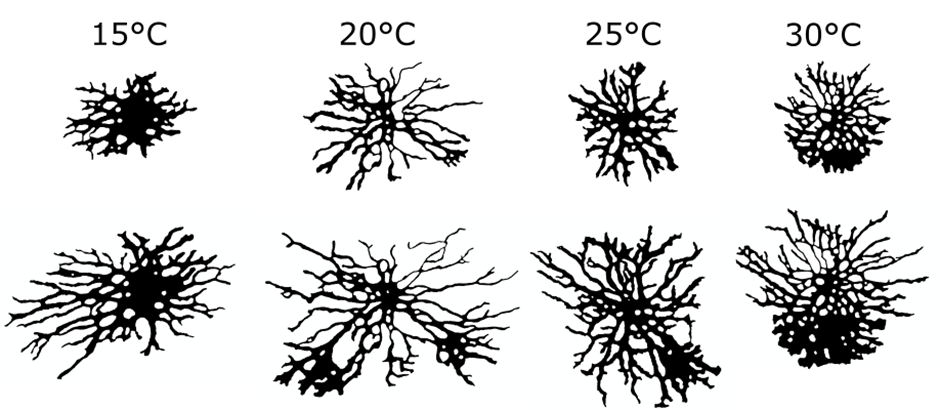
Screen shots from the time-lapse video of the growing galleries.

IS: What’s next for this type of research?

“There’s still a lot we don’t know about what happens at the individual level when ants dig these intricate underground networks. In our study, we didn’t focus on the detailed behavior of individual ants as they carve out tunnels in the soil. But what they do, how they decide where to dig, how new branches start, are all incredibly interesting questions. Some of this behavior can be seen in action in a real-time video clip from our experiments. Analysing in detail this type of footage is fascinating, but could easily become an heavy research task.

Another promising direction for this research would be looking at the internal structure of natural nests in the wild: how do galleries inside the mound differ, depending if the mound was built in a sunlit area compared to a shady one?Are there shape differences between the northern exposed and the southern side of the mound?

The nests built by social insects are more than just shelters: they are the physical records of the life and activity of a colony. If we learn to better read the information written in these structures, we might uncover new insights into the hidden lives of these wonderful insects”.

References:

Rathery, A., Facchini, G., Halsey, L.G., Perna, A. High environmental temperatures put nest excavation by ants on fast forward: they dig the same nests, faster. Insect. Soc. (2025). https://doi.org/10.1007/s00040-025-01049-7

Facchini, G., Rathery, A., Douady, S., Sillam-Dussès, D., Perna, A. (2024). Substrate evaporation drives collective construction in termites. Elife, 12, RP86843. https://doi.org/10.7554/eLife.86843.4

At what point does a male social wasp leave his natal nest to reproduce?

By Daniela Torres Garcia

In this blog, Daniela Torres Garcia, from the University of São Paulo, describe how she discovered that the number of females in a Mischocyttarus cerberus wasp nest influences the departure of males for mating. This latest research on social insects can be read here.

In social hymenopterans, male reproductive success depends entirely on the timing of reproduction, as males play no role in maintaining the colony—at least in the widely studied species. Males of many species, including social wasps, undergo post-pupal sexual maturation within the natal nest before dispersing to mate, during which time they rely on their nestmates for protection and food.

This leads us to a key question: do all males leave the nest at the same time, or is there something that makes some of them stay longer or shorter in their natal nest?

To answer this, we observed a population in southeastern Brazil of the Neotropical species Mischocyttarus cerberus. We conducted a rigorous monitoring of the nests of this species over several weeks to track male dispersal, and we found that the time a male spends in the nest before leaving varies. Some males leave the day after emerging, while others remain for almost a week.

Nest of M. cerberus with females and males. Photo by Andres Rodrigues De Souza.

Given this variability, we asked what factors might be influencing male dispersal timing. Does the social context affect this variability? That is, does the number of adult females in the nest influence how long the males stay? Do males stay longer when more adult females are present?

We addressed these questions using two approaches: on the one hand, observationally, by monitoring 36 natural nests; on the other hand, experimentally, by manipulating the number of females in 22 nests to see whether this caused a change in male dispersal behavior. And what did we find? Males in nests with more females stayed longer, thereby delaying their dispersal.

On average, males left after 3 days, but some took up to 8 days. We found that in nests with three females, males stayed for about 2.8 days, whereas in nests with only one female, they left after just 1.7 days. This suggests that females modulate male dispersal, which can last up to 8 days—similar to another social wasp, Polistes lanio (up to 7 days) (Southon et al., 2020). Why? Probably because staying in the nest is safer and more comfortable. More females mean better defense against predators and more food available. It is worth remembering that the sting—the primary defense mechanism of this group—is associated with the female reproductive system and thus is absent in males.

Male M. cerberus resting on the underside of a leaf within the study area. Photo by Andres Rodrigues De Souza.

Therefore, it is not surprising that males from nests with more females delay their dispersal to complete their sexual maturation in a safer and more comfortable environment, thereby increasing their survival and future reproductive competitiveness (i.e., by accumulating energy reserves). The accumulation of these reserves could help them avoid having to expose themselves on flowers to obtain food once dispersed.

Taken together, these results highlight the role of social context in shaping male reproductive strategies and suggest that pre-dispersal social life may be an underestimated factor in the physical fitness of males in social insects.

The reproductive biology of male social insects has often been studied at mating sites, such as leks and swarms (Beani et al., 1992; Beani et al., 2014). However, less attention has been given to male behavior prior to reaching these sites (e.g., Southon et al., 2020), despite its potential to influence male competitive ability. Therefore, pre-dispersal social life may be an overlooked aspect of male paper wasps’ reproductive strategies.

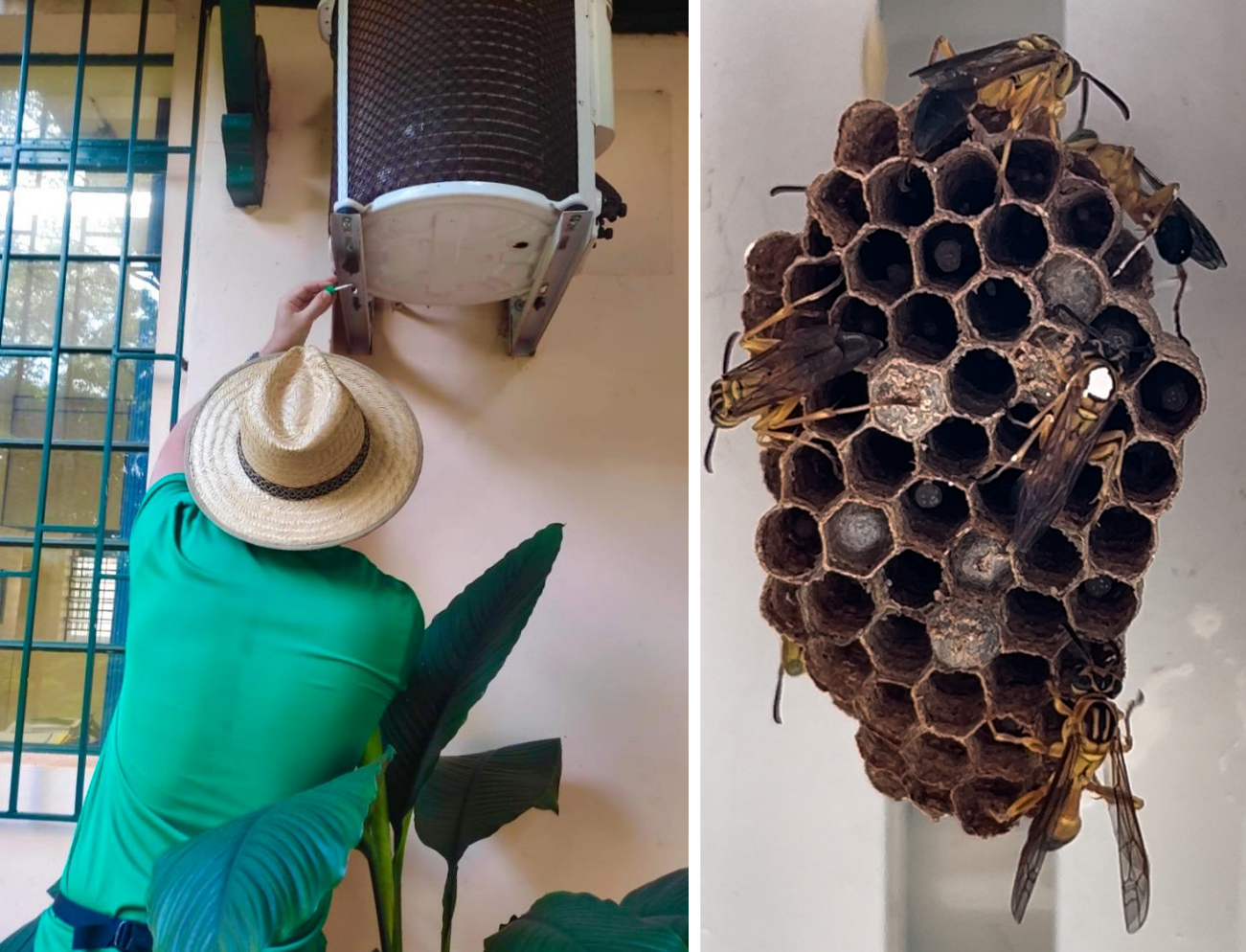
Left: Researcher tagging M. cerberus males for tracking, under an air conditioning unit. Right: M. cerberus nest under study, with several workers visible on the cells

References

Beani L, Dessì-Fulgheri F, Cappa F, Toth A (2014) The trap of sex in social insects: from the female to the male perspective. Neurosci Biobehav Rev 46:519–533. https://doi.org/10.1016/j.neubiorev.2014.09.014

Beani L, Cervo R, Lorenzi CM, Turillazzi S (1992) Landmark-based mating systems in four Polistes species (Hymenoptera: Vespidae). J Kansas Entomol Soc 8:211–217 https://www.jstor.org/stable/25085358

Garcia, D. T., Santos, E. F., Santos, S. A., do Nascimento, F. S., Krams, I., Rantala, M. J., & de Souza, A. R. (2025). Social context predicts male dispersal in nests of a paper wasp. Insectes Sociaux, 1-4. https://doi.org/10.1007/s00040-025-01050-0

Southon, R. J., Radford, A. N., & Sumner, S. (2020). Hormone-mediated dispersal and sexual maturation in males of the social paper wasp Polistes lanioJournal of Experimental Biology223(23), jeb226472.

Sunning clusters, the remarkable phenomenon in red wood ants: What causes their occurrence?

By Peter Chanas

Peter recently completed his Ph.D. at Charles University in Prague. During his doctoral study, he focused on the formation of sunning clusters, the phenomenon in red wood ants as a part of their nest thermoregulation. Currently, he is looking for a research position on ants. Read his latest article in Insectes Sociaux here.

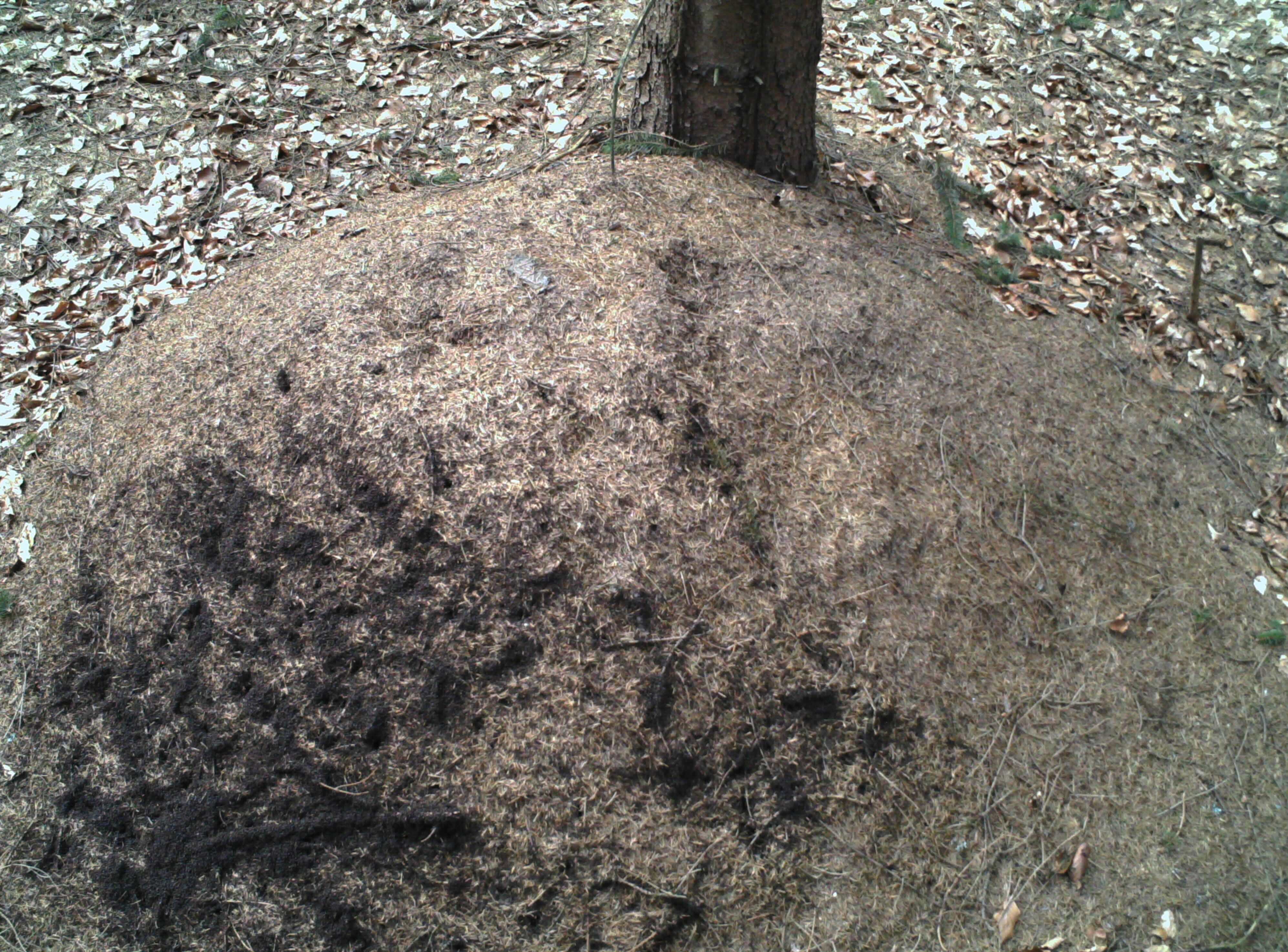
While walking in the European coniferous forest during early spring, some large hills are covered by needles; these are the anthills. If you get closer and look at one of them closely, you will notice a black spot on the nest surface. These are red wood ants, Formica polyctena. They often form huge and dense clusters on the nest surface, in which many ant workers (even queens!) are involved throughout the whole spring.

A close-up view of densely overlapping ant workers of Formica polyctena forming a sunning cluster. How many ant queens can you find here? © Peter Chanas

You may be asking intuitively: Why are they doing this on the nest surface? A long time ago, Zahn (1958) suggested that when ants return to their nest after sun basking, they could transfer heat and thus contribute to the increase in nest temperature. It has been confirmed that sun-basking behavior contributes to the spring nest heating (Chanas and Frouz 2025b). Although the effect on the nest temperature is low, there are other factors which can contribute to the spring nest heating within overall nest thermoregulation. And that is what our research questions were: What factors cause the ants to form clusters on the nest surface? How often do clusters occur?

Sunning clusters, the remarkable phenomenon, occurred in all nests we studied. We were surprised that there was no significant relationship between the occurrence of sunning clusters and nest volume and nest shading, even though such nest properties were shown as crucial in ant nest thermoregulation (see references in our article). Our results suggest that there is a high variation of workers performing sun-basking behavior among individual nests, as similarly shown by Kadochová et al. (2017). It also means that each nest has slightly different microclimatic conditions. Each nest inhabits many ant individuals, which can behave according to it and then ensure optimal temperature conditions in the given nest.

  • Why do we call clusters “sunning?” Because when the sun shines, ants form clusters on the nest surface, and the main heat source is the sun, so they form “sunning clusters.” This is their distinctive and conspicuous behavior, and it has attracted the attention of several scientists interested in ant nest thermoregulation.

The frequency of clusters strongly depends on the nest temperature and the duration of daylight, unlike the air temperature, which has a lower effect. Thus, at lower nest temperature, ant workers tend to form sunning clusters during warm periods of the day, with a higher outside temperature. At higher nest temperature, clusters are formed during the cold period of the day. We found that the breaking point of the nest temperature where clusters peaked was 4.68°C and of the daylight was 12 h and 40 min. After that, sunning clusters declined very slowly, which you can see only by the statistics. The low nest temperature is very interesting; we expected a different breaking point of nest temperature. Why such a low nest temperature? But sun-basking behavior is just one of several mechanisms within nest thermoregulation. The fact that you do not know something is even more interesting because you can still further ask, think, and feed your curiosity by trying and setting up new experiments and expanding knowledge and contributing to the science and then the whole society to moving on.

Sunning clusters did not completely disappear at the nest temperature above 20ºC, where the opposite was shown by Kadochová et al. (2019). There was rather a gradual decline of clusters. Higher nest temperature accelerates reproduction and is crucial for their proper brood development (Rosengren et al. 1987, Porter 1988). At such high nest temperature, they do not need to further form sunning clusters. Although some workers can still perform sun-basking behavior by their individual need.

If you look at the daily dynamic of occurrence of clusters, you can see that the pattern is different in early spring and different in late spring. Thus, the daily dynamic changed significantly in early and late spring (Fig. 2). In early spring, when the nest temperature is low, sunning clusters peaked in late morning and then decreased. In late spring, however, we found that once a nest heated up, the clusters became much less frequent and occurred without a clear diurnal pattern but in obvious association with colder weather.

Based on Chanas and Frouz 2025.

We had a huge dataset. A large dataset was generated, including nineteen cameras (Fig. 3). By using the cameras, we were able to notice something that the ordinary eye would not notice in the field. When you have “more eyes” looking at something, you are more likely to notice things you had not considered—because the mind tends to only see what it is prepared to see. In this case, we noticed clusters in association with colder weather that occurred sometime even in late spring. Such clusters we called “non-sunning clusters” (Fig. 4). This was a surprising finding, prompting the question: Why do they occur there under a cloudy sky or in cold weather for most of the day in early spring—and sometimes even during brief periods in late spring? These clusters likely have no significant effect on the regulation of nest temperature. But it can bring new insight into the organisation of ant colonies, but it needs further investigation. Currently, we are working on further findings based on another dataset that will expand our knowledge of ant nest thermoregulation.

One scouting camera from nineteen cameras installed on a tree used to record the occurrence of sunning clusters on the nest surface during spring. Peter would like to thank the field assistants: Jaroslav Kukla, Veronika Jílková and Štěpánka Kadochová, for their help with the installation of scouting cameras on trees. © Peter Chanas
Example of non-sunning clusters” recorded by the scouting camera. Such clusters only occasionally occurred during the day in early spring. © Peter Chanas

Since ants are ectothermic animals, the formation of clusters can be quite “mechanical”. Due to their reaction to change the nest temperature and environmental conditions. A simple and plausible algorithm for cluster formation could be based on environmental conditions and social cues: in cold weather and in the presence of other workers on the nest surface, individuals tend to cluster together. When the nest surface is cold, they seek sunlight when available; when it becomes hot, they move into shaded areas to avoid overheating (Kadochová et al. 2019). Similar to how people enjoy basking in the sun during early spring but more avoid it during the peak of summer, red wood ants adjust their behavior based on nest and air temperature. However, unlike humans, they form clusters—an adaptive strategy that reduces their surface-to-volume ratio, helping to minimize heat loss compared to individual ant workers.

In conclusion, red wood ants tend to form clusters on the nest surface in early spring when nest temperatures are low or when workers are exposed to cold conditions. This behavior likely persists into late spring during chilly mornings, evenings, or periods of cold weather. In essence, the formation of sunning clusters is closely tied to nest temperature, air temperature, and daylight availability. Red wood ants appear to integrate cues from both inside the nest (internal temperature) and the external environment (sunlight or cold) to decide whether or not to form sunning clusters on the nest surface.

References

Chanas P., Frouz J. 2025b. Sunning clusters of ants contribute significantly, but weakly to spring heating in the nests of the red wood ants, Formica polyctena. Eur. J. Environ. Sci. 15: 28–33. https://doi.org/10.14712/23361964.2025.4

Kadochová Š., Frouz J., Roces F. 2017. Sun basking in red wood ants Formica polyctena (Hymenoptera, Formicidae): Individual behaviour and temperature-dependent respiration rates. PLoS ONE 12(1): e0170570. https://doi.org/10.1371/journal.pone.0170570

Kadochová Š., Frouz J., Tószögyová A. 2019. Factors influencing sun basking in red wood ants (Formica polyctena): a field experiment on clustering and phototaxis. J. Insect Behav. 32: 164–179. https://doi.org/10.1007/s10905-019-09713-0

Rosengren R., Fortelius W., Lindström K., Luther A. 1987. Phenology and causation of nest heating and thermoregulation in red wood ants of the Formica rufa group studied in coniferous forest habitats in southern Finland. Ann. Zool. Fennici 24: 147–155.

Porter S.D. 1988. Impact of temperature on colony growth and developmental rates of the ant, Solenopsis invicta. Journal of Insect Physiology 34: 1127–1133. https://doi.org10.1016/0022-1910(88)90215-6

Zahn M. 1958. Temperatursinn, Wärmehaushalt und Bauweise der Roten Waldameisen (Formica rufa L.). Zoologische Beiträge 3: 127–194.

Interview with a Social Insect Scientist: Ben Hoffmann

Ben Hoffmann is a researcher based in Australia, focusing on invasive species management. His recent work on invasive red fire ants can be found here.

IS: Who are you, and what do you do?

BH: I am a mid-career researcher based in Darwin, northern Australia, and these days I am predominantly focused on sciences that improve invasive species management, especially achieving ant eradications. That can be as broad as demonstrating the utility of advanced drones, to studying the basic biology of species to determine key aspects that need to form the basis of work protocols.

A recent photo of Ben taken in Hawaii.

IS: How did you develop an interest in your research?

BH: I was always interested in nature, but in 1990 I did one week of school work experience with Alan Andersen at CSIRO, and ants then became my life passion. I basically never stopped coming to the laboratory with ants that I collected, and then I ended up doing both my undergraduate and postgraduate studies at CSIRO, and ultimately created a job for myself as well. The ants in northern Australia were so incredibly unknown back then, and it was so easy to just go out and find new species, even from my own backyard.

IS: What is your favorite social insect, and why?

BH: Certainly ants over other social insects, but I don’t think I have a favourite ant. I can spend all day just looking at the huge diversity of ants under a microscope, let alone appreciating their incredibly varied biologies and ecologies.

IS: What is the best moment/discovery in your research so far? What made it so memorable?

BH: Oh, there are so many. The joy of having a paper accepted for publication never ceases. But possibly a “best” moment has occurred multiple times when I have successfully achieved an eradication when others have said that it isn’t possible. I do enjoy proving that things are possible.

IS: Do you teach or do outreach/science communication? How do you incorporate your research into these areas?

BH: A little bit. There is always a school group that wants a presentation about ants or being a scientist, or a community group that is interested in knowing what science is being conducted anywhere. Probably my biggest interaction is communicating with the public when invasive species eradication work is conducted on private lands.

IS: What do you think are some of the important current questions in social insect research, and what is essential for future research?

BH: I suspect that I am not following the literature or science focus of most social insect research, only what I learn is important for my work. More often than not these days, it is just basic biology that I am chasing in the literature, and for most species there is practically nothing. I am actually looking forward to retirement so that I can stop chasing grants focused on somebody else’s priorities, and just conduct studies of basic biology. The work would not be interesting to most, but it can be very useful when it is needed.

IS: Outside of science, what are your favorite activities, hobbies, or sports?

BH: As a kid I loved bird watching, and in the past few years I have regained this passion, probably because of the incredible eBird database. My spare time and trips anywhere in the world now involve a lot of bird watching.

Ben and Magen Pettit (his technician) birdwatching in Brazil after the 2018 IUSSI conference.

IS: What is the last book you read? Would you recommend it? Why or why not?

BH: Around the world in 80 birds. It is simply a book about a selection of the world’s bird species and interesting details about them. There is a great opportunity here for somebody to do exactly the same for ants. Nice and easy to read, no plot to remember as I find ten minutes here and there to read a few more pages, and good for increasing knowledge.

IS: How do you keep going when things get tough?

BH: These days I exercise a lot, typically an hour fast walking in the morning, sometimes jogging, and often an hour of swimming in the afternoon. Exercise does a lot to release tension and give thinking time. As much as possible I enjoy the outdoors, and when the weather is good I go camping a lot (even if times aren’t tough). I also discuss any issues with people who might like to listen or even give advice. Among all of that I keep myself charged and enthusiastic as much as possible to find solutions to the many (and seemingly increasing) problems that I face.

IS: Who do you think has had the most considerable influence on your science career?

BH: Easily Alan Andersen. He is an incredible ecologist, regardless of whether the topics is ants or not, he is an incredibly likable person, he is a great science leader, a prolific publisher, etc etc etc. Even in his retirement he is publishing more papers than me which shows me I still have room for improvement.

Photo taken back in 1999, of Ben (middle), Alan Andersen (right), and Jerome Orgeas (left) visiting from France.

IS: What advice would you give to someone hoping to be a social insect researcher in the future?

BH: Go for it! There is plenty of scope and need for such research, regardless of whether the insects are the research focus or just the model taxon being used to test something else.

IS: Has learning from a mistake ever led you to success?

BH: Plenty of times. In fact, it could be argued that most of my career has been based on learning from mistakes. Most of my focus has been how to eradicate species from a landscape, but without causing harm to the landscape, and it is easier said than done. Certainly more failures than successes, but the failures just get you to change what is done until success is achieved. You can read about plenty of my failures in my publications, and I have always found it important to publish my failures so that other people can potentially avoid doing exactly the same and achieve the exact same failed outcome.

IS: What is your favorite place science has taken you?

BH: I love working in NE Arnhem Land, which is stunningly beautiful Aboriginal lands in northern Australia, but then again Lord Howe Island and Norfolk Island are also jewels of the world that I have always loved traveling to. Likewise, I have had the pleasure of travelling to over 40 countries and enjoy a vast array of beautiful places. Don’t think I could settle on a “favourite”.

Camping on a beach in Arnhem Land, Australia with Mogens and Dorthe Nielsen from Denmark in 2005.