The surprising vulnerability of a termite’s secret roomate

By Igor Eloi

Igor is a PhD student based at the UFRN campus on the brazilian coast. He is fascinated by how social insects, like termites, behave and interact with other species. In this blog, he shares key insights from a research paper exploring how fragment edges affect termite guests. His lastest research in Insectes Sociaux can be read here.

A termite nest is more than a mound of earth and wood; it’s a bustling city, a climate-controlled fortress engineered and built by tiny insects. These complex structures are not just homes for termites, a rather exquisite diversity of organisms have evolved to life within their walls.

There residents are known as”termitophiles”—organisms that live their entire lives, or at least critical parts of them, in an obligatory relationship with termite society. They are not merely guests but are deeply integrated into the colony’s day-to-day routine. These creatures have evolved alongside their hosts for millennia, developing bizarre forms and behaviors to survive and thrive inside the fortress. Which raises a rather pertinent question: If a creature is perfectly adapted to live inside a protective, self-regulating termite nest, does that make it immune to changes in the outside world? In other words, what happens to these hidden, highly specialized residents when human activity, like a simple dirt road, encroaches on their world? Our study set out to find the answer, revealing just how far the ripples of habitat disturbance can travel.

We focused on studying two Aleocharinae beetles, that live in an asymmetric “obligatory relationship” with a their host. This means that while termites live fine without the beetles, the beetles themselves cannot survive without the colony. We examined two distinct types found in the arboreal nests of the termite Constrictotermes cyphergaster (Nasutitermitinae).
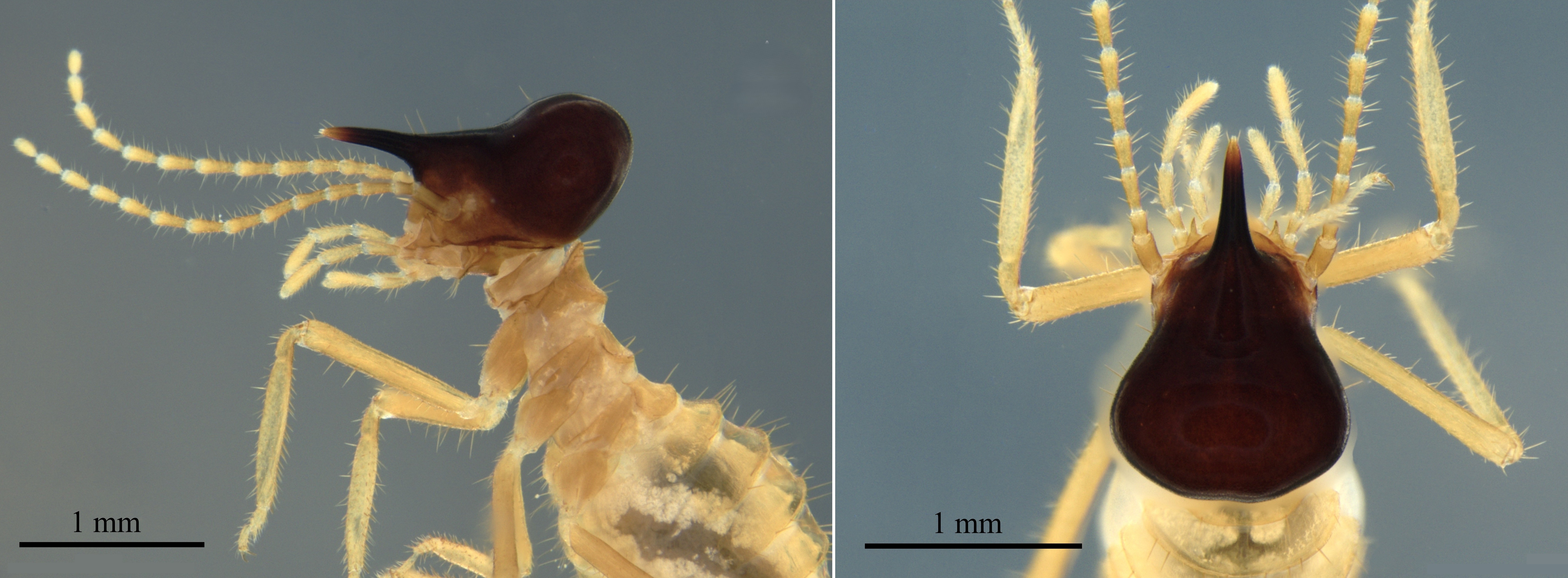
Lateral (left) and dorsal (right) views of the termite Constrictotermes cyphergaster (Nasutitermitinae), host species of the studied Aleocharinae beetles.

On the image below, the first, Termitocola silvestrii, is a miniature tank. This species is equipped with a “limuloid” or drop-shaped body, featuring a large, shield-like pronotum thought to be a defensive adaptation against termite attacks. Anecdotal observations suggest it may act as part of the colony’s cleanup crew, feeding on dead termites. While these beetles possess wings, researchers speculate they may lose the ability to fly after successfully settling within a host colony. This secret society has its rules, and both species rely on momentarily leaving the nest—either for reproduction or dispersal—exposing their hidden world to the conditions of the wider forest.

Lateral and dorsal views of the rove beetle Termitocola silvestrii, a limuloid (drop-shaped) Aleocharinae species associated with the termite Constrictotermes cyphergaster. The large, shield-like pronotum is thought to provide protection against termite attacks.

The second, Corotoca fontesi, has a bizarre “physogastric” body, with a swollen, soft abdomen that gives it a strange, almost larval appearance and reduces its mobility. Its life cycle is a drama of dependence and risk. To reproduce, the female must venture outside the nest during the termites’ open-air foraging expeditions (Moreira et al. 2019). She then deposits a single, motile larva into the ground litter. The larva develops alone in the soil, and how it later finds and integrates into a new host nest remains one of the fascinating mysteries of its life cycle.
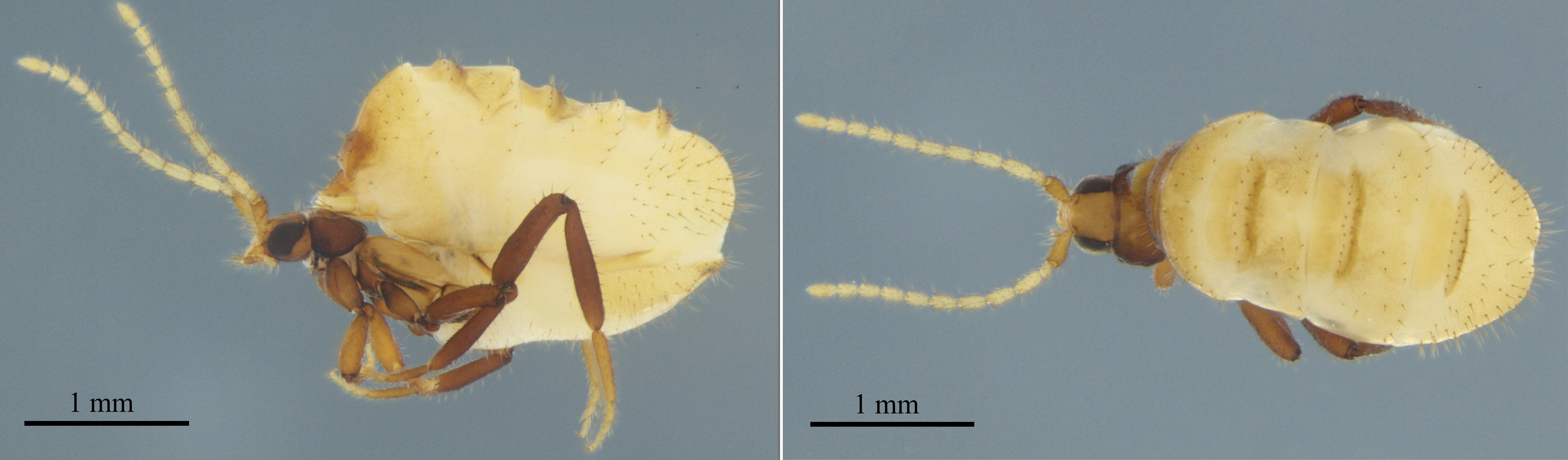
Lateral and dorsal views of the rove beetle Corotoca fontesi, a physogastric Aleocharinae species associated with the termite Constrictotermes cyphergaster. The swollen, soft abdomen gives the beetle a larval-like appearance.

The central finding of our study is that despite living inside the protective, climate-controlled environment of a termite nest, the abundance of these specialized beetles is negatively impacted by proximity to a forest edge. This finding demonstrates that the so-called “edge effect”—the ecological changes that occur where two habitats meet—penetrates the defenses of the termite fortress.

One might assume that the nest would act as a perfect buffer against external environmental stressors. However, the study’s results suggest otherwise, highlighting that even for organisms living deep within a host structure, the human-made landscape changes of the outside world matters immensely.

Finally, it is our thought that the mechanisms behind the impact of edge effect over the abundance of termitophiles might lie in one (or the combination) of these:

  1. Direct Impact: The harsher environmental conditions at the forest edge—such as different temperatures or humidity—could directly harm the beetles during the parts of their life cycle spent outside the nest. For example, the larvae of Corotoca developing in the soil could be exposed to increased predation or unsuitable microclimates (Zilberman et al. 2019).
  2. Host-Mediated Impact: The termite colonies themselves might be stressed by the edge conditions. This could make them “lower-quality hosts,” perhaps with fewer resources or a smaller workforce, rendering them unable to support large populations of their beetle symbionts.
  3. Dispersal Limitation: The altered landscape near the road could act as a barrier. This might make it more difficult for adult beetles to travel between nests, limiting their ability to find and colonize nests located near the forest edge.

References:

Moreira IE, Pires-Silva CM, Ribeiro KG, et al (2019) Run to the nest: A parody on the Iron Maiden song by Corotoca spp.(Coleoptera, Staphylinidae). Papéis Avulsos De Zoologia 59:e20195918–e20195918.

Siqueira-Rocha, L., Eloi, I., A Luna-Filho, V. et al. Aleocharinae termitophiles are affected by habitat fragmentation in deciduous dry forests. Insect. Soc. (2026). https://doi.org/10.1007/s00040-025-01076-4

Zilberman B, Pires-Silva CM, Moreira IE, et al (2019) State of knowledge of viviparity in Staphylinidae and the evolutionary significance of this phenomenon in Corotoca Schiødte, 1853. Papéis Avulsos De Zoologia 59:e20195919–e20195919. https://doi.org/10/gng3q8

Interview with a social insect scientist: Stefano Cavallo

Stefano is a biologist specializing in animal behavior and currently works as a research fellow in behavioral ecology at the University of Florence. In this interview, he recalls moment he realized that even ants show individual personalities. His lastest research in Insectes Sociaux can be read here.

IS: Who are you, and what do you do?

I’m Stefano Cavallo, a passionate biologist specialized in animal behaviour. I’m living in Pisa and currently work at the University of Florence as a research fellow in behavioural ecology. My interests range from communication and cognitive aspects of animal behaviour in invertebrates and beyond. At the moment, my project focuses on exploring phenotypic plasticity—particularly behavioural plasticity—in marine decapods.

IS: How did you develop an interest in your research?

Since I was a child, I’ve always been passionate about animals. Although I grew up in a city, I had the chance to keep and observe a variety of species—fish, amphibians, reptiles, birds, mammals, and of course, insects. Among them, social insects, and especially ants, have always fascinated me. Their remarkable social organization combined with apparent simplicity sparked both curiosity and deep biological admiration in me. As my studies in biology progressed, I developed a strong interest in behavioral biology. What I find most stimulating is the possibility of identifying similar behavioral patterns in evolutionarily distant species, both human and non-human.

IS: What is your favorite social insect, and why?

It’s hard to choose just one. I’m fascinated by social insects for very different reasons: for instance, the interspecific relationships of Atta ants, the communicative flight and cognitive abilities of Apis mellifera, and the complex social structure of Polistes dominula all capture my interest. What I find most stimulating is not a single species, but rather those organisms capable of challenging the “dogmas” of biology. For example, the recent discovery by Juvé et al. (2025) on Messor ibericus which destroy species definitions.

IS: What is the best moment/discovery in your research so far? What made it so memorable?

One of the best moments in my research was when I first realized that even ants—creatures we often think of as identical and mechanical—show individual personalities. That realization was unforgettable: it felt like discovering a hidden layer of complexity within a familiar world. From that moment on, I stopped seeing colonies as uniform units and started seeing them as societies of individuals.

IS: Do you teach or do outreach/science communication? How do you incorporate your research into these areas?

No, at the moment I don’t deal with these aspects but in the future I hope it can become part of my job as a scientist. I think it is important to disseminate scientific advances to a wide audience and shorten the distances between laboratories, research and the general public.

IS: What do you think are some of the important current questions in social insect research, and what is essential for future research?

As we know, the environment today is subject to strong anthropogenic pressures and global warming is shaping habitats very quickly. The effects on social insects are still poorly understood. I believe it is essential to focus on these aspects and understand how changing conditions act on the biology and behavior of social insects.

IS: Outside of science, what are your favorite activities, hobbies, or sports?

I love being in nature, trekking in the mountains, climbing, swimming and snorkelling

IS: What is the last book you read? Would you recommend it? Why or why not?

The last book I read was Entangled Life: How Fungi Make Our Worlds, Change Our Minds and Shape Our Futures by Merlin Sheldrake. I would definitely recommend it—it’s a fascinating and beautifully written synthesis of what we know about fungi. These organisms are extraordinary in the way they challenge traditional paradigms of biology and reveal how deeply interconnected life really is.

IS: How do you keep going when things get tough?

I practice tai-chi and mindfulness techniques to stay in the present moment and focus on beautiful things.

IS: If you were to go live on an uninhabited island and could only bring three things, what would you bring? Why?

I would bring a knife, a tinderbox and a book on edible plants. These three things would help me get food, be able to cook and warm up and not die of intoxication haha!

IS: Who do you think has had the most considerable influence on your science career?

I believe that the most important role was played by two high school teachers. My chemistry professor and biology professor taught me scientific rigor and wonder at the living world

IS: What advice would you give to someone hoping to be a social insect researcher in the future?

If I had to advise someone to hop to be a social insect researcher, I would tell them to follow the thirst for knowledge and not stop at appearances. I would ask him to always look with a critical eye at those who claim to have absolute certainties in biology.

IS: Has learning from a mistake ever led you to success?

I couldn’t point to a specific mistake, but I believe that in private life and at work we often learn by falling and making mistakes. Trying by trial and error: this is generally just how we manage to grow.

IS: What is your favorite place science has taken you?

My favourite place where science took me is Paris, in the experimental and comparative ethology laboratory of the Sorbonne University in northern Paris. I was lucky enough to work in the group led by Professor Patrizia d’Ettore who with dedicated passion dedicates herself to research in the myrmecological field.