How does a caterpillar use its tentacles to get the attention of ants?

By Amalia Ceballos-González

In this blog, Amalia from the University of São Paulo tells the story of how she and her colleagues studied a strange functional behaviour in a myrmecophilous riodinid caterpillar. Read her latest article in Insectes Sociaux here.

Caterpillars that establish close interactions with ants have developed various adaptations to maintain the ants’ attention. These adaptations involves specialized organs that produce nutritional rewards or chemical signals to attract ants. The butterfly families Lycaenidae and Riodinidae provide many examples of myrmecophilous caterpillars, including species with these organs. In our recent study, published in Insectes Sociaux, we explored the impact of these specialized organs on ants by focusing on a species from the less-studied family Riodinidae, Synargis calyce, which interacts with various ant species. In our study area, the most frequent interaction involved the ant species Camponotus crassus.

Caterpillars of Synargis calyce interacting with different ant species. (a) With Camponotus crassus, (b) with Camponotus renggeri, (c) with Wasmannia auropunctata, and (d) with Paratrechina longicornis. ©Amalia V. Ceballos-González.

Caterpillars of this species possess two pairs of tentacular organs. The first pair, known as ATOs (Anterior Tentacle Organs), likely release volatiles that influence ant behavior, although there is insufficient evidence to confirm this. The second pair, known as TNOs (Tentacle Nectary Organs), secrete a nutritive substance (primarily composed by sugars and amino acids) that ants consume. Whether these organs work synergically or if one is more relevant than the other was still unclear for our study species and it is also the case for many other species of the family Riodinidae.
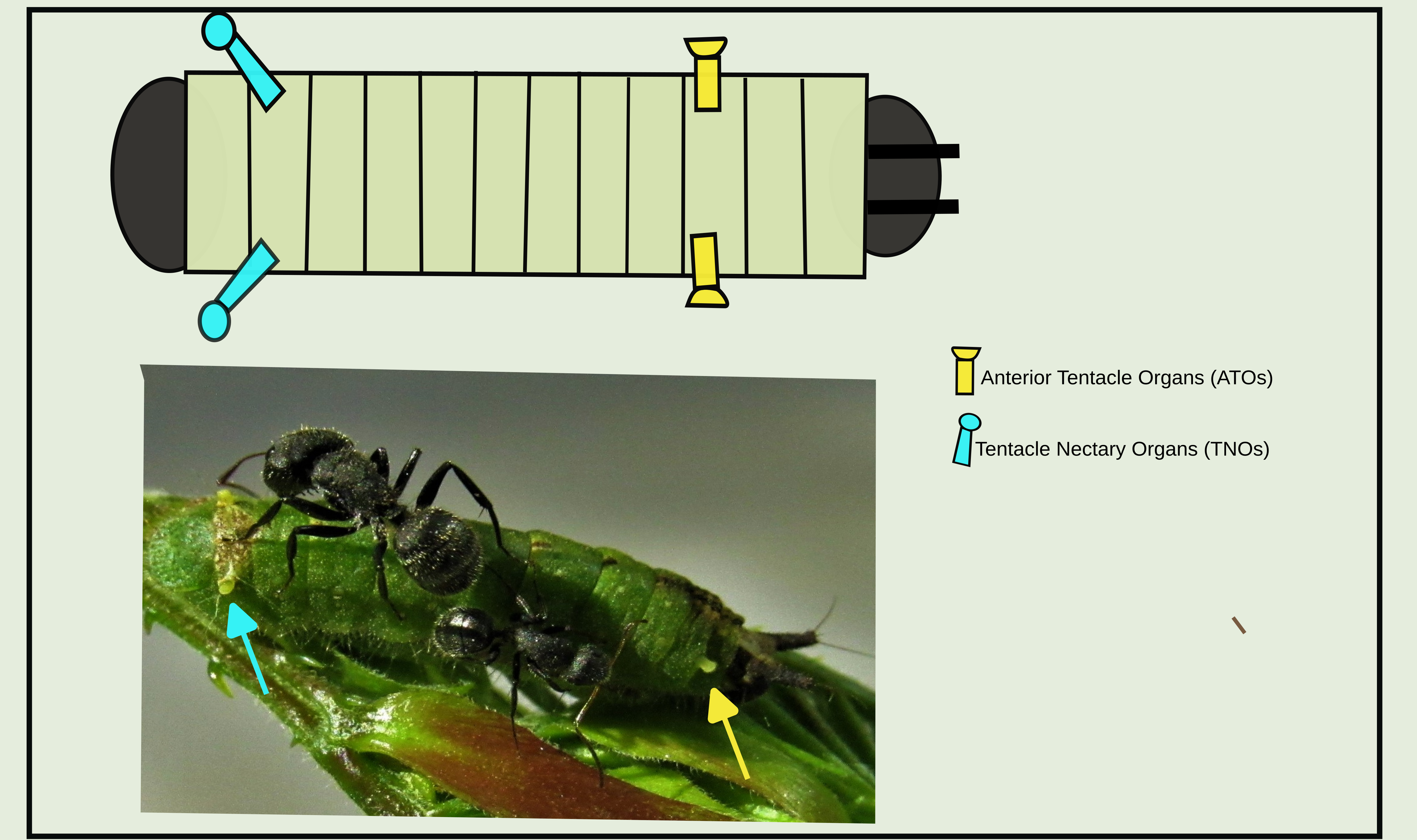
Illustration showing the position of the tentacular organs (TNOs and ATOs)  in a caterpillar of the Riodinidae family. Below, a photograph of Synargis calyce indicates the two pairs of tentacular organs with arrows (Yellow = ATOs, Blue = TNOs). Drawing adapted from DeVries (1991). ©Amalia V. Ceballos-González.

To uncover those aspects, we aimed to explore this pair of tentacular organs by checking ants’ reaction. Our research was conducted at the University of São Paulo, Ribeirão Preto campus. Our first objective was to create an ethogram documenting the behavioral interactions between caterpillars and ants. During these observations, we identified a striking behavior. The ethogram revealed that after the eversion of ATOs, ants exhibited stereotyped “jumping” behavior. This behavior involved ants rapidly lifting their legs and jumping towards the caterpillar’s head.
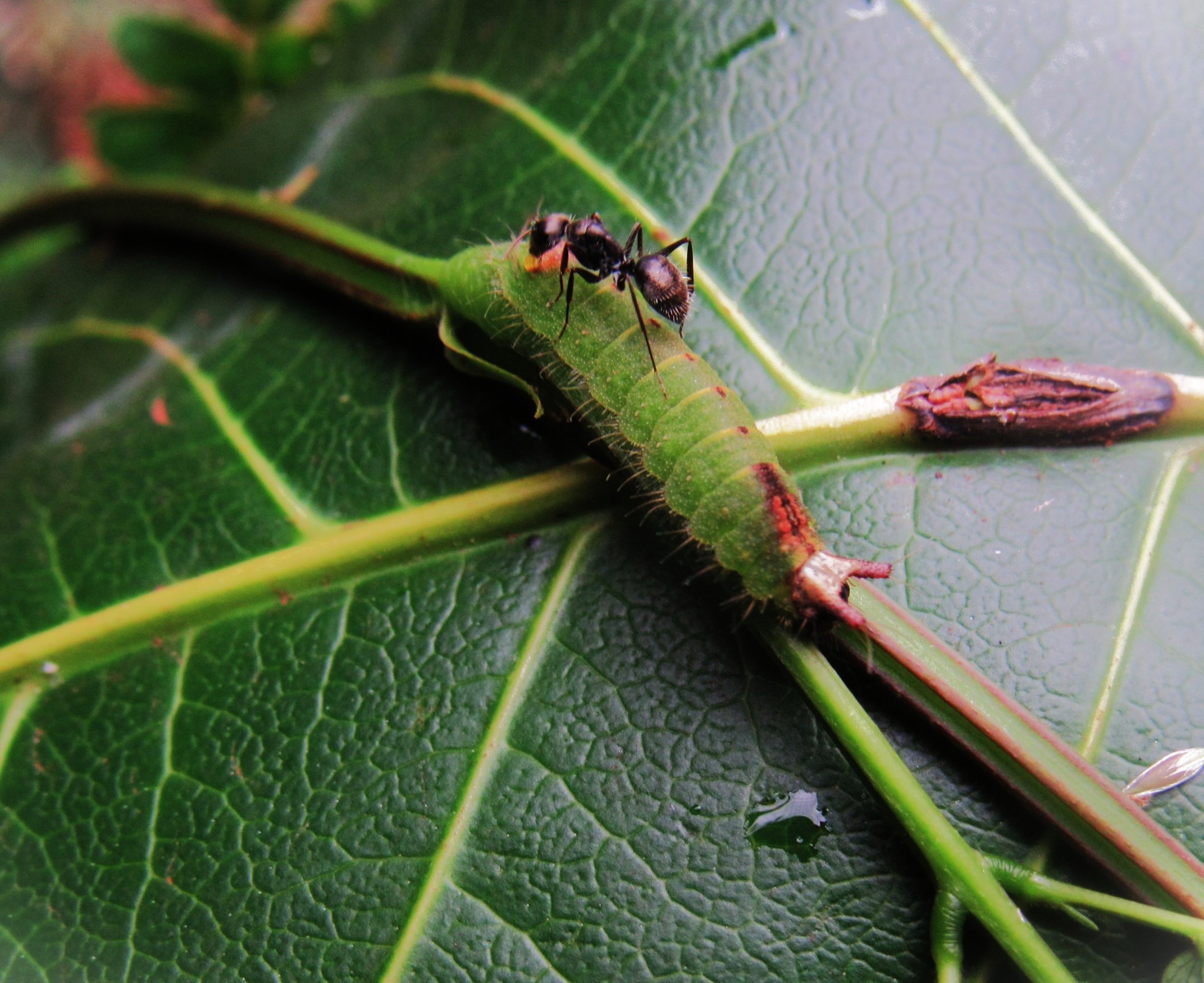
 Synargis calyce caterpillar interacting with a Camponotus ant.

Next, we conducted experiments in which we experimentally manipulated – by allowing or preventing them to evert – the two types of caterpillar organs (TNOs and ATOs), to determine their role in maintaining ant attendance. Our findings demonstrated that TNOs are more effective in maintaining the attention of attendant ants, likely due to the rewards these organs provide. However, we also found that caterpillars with only functional ATOs received more attention compared to those with neither organ functioning. This indicates that TNOs play a central role in sustaining ant-caterpillar interactions, while ATOs serve a complementary function.

Three caterpillars (possibly third instar) interacting with Camponotus ants.

In conclusion, the interactions between S. calyce caterpillars and attendant ants are primarily driven by the rewards produced by TNOs, with ATOs playing a smaller, supportive role. These findings are consistent with observations in Lycaenidae species, which exhibit similar mutually beneficial relationships with ants. The evolution of these organs may represent a case of convergent adaptation to environmental pressures experienced by caterpillars in both families.
Ants and their commensals: The intriguing presence of other groups in ant nests

By Mariane Dias-Soares and Cléa S. F. Mariano

In this blog, Mariane Dias-Soares and Cléa Mariano explore the diverse organisms cohabiting ant nests in the Neotropics, from gastropods to myriapods. They explain how do these guests interact with ants, sharing resources and space within the nest environment. Discover more about these intriguing interactions in their latest work for Insectes Sociaux, here.

What attracts these other groups? What are these groups? Are there really gastropods inside ant nests? What are commensals? Do ants benefit from their presence? Why aren’t they expelled? These are some of the most frequent questions when the topic of conversation is our research and our article. Let’s now address each of these questions, the work done so far, and the next steps toward the discoveries that researching an ant nest provides us…

The ant nests provide a protected environment for the workers, the queen, and all of their immatures, as well as storing food and maintaining stable temperature and humidity. When studying these nests, the presence of other groups was observed, which, attracted by these resources, coexist with the ants. These groups may spend part of their life cycle inside the nests or even their entire existence.

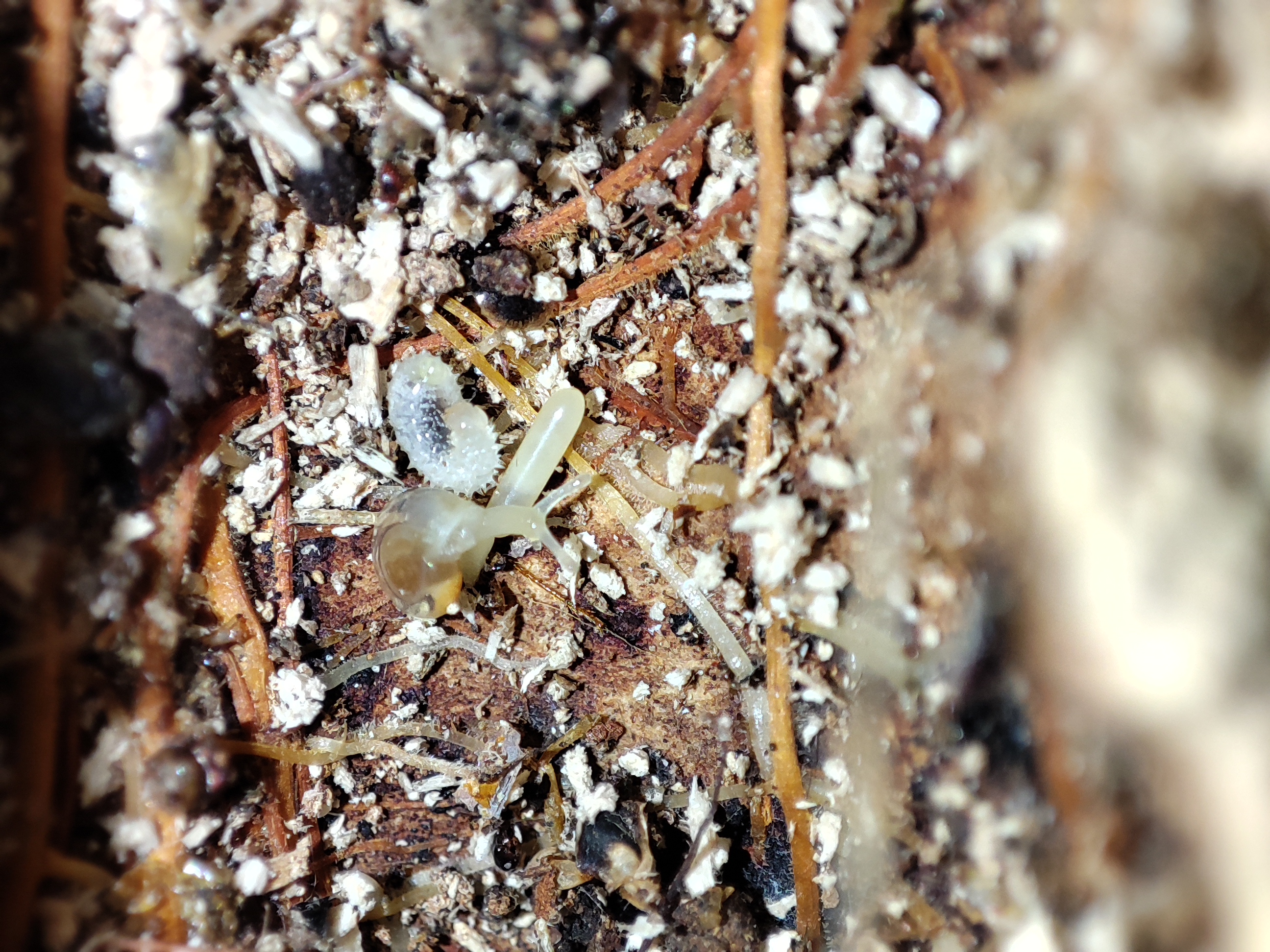
Gastropod near the immatures of N. verenae. Photo: Laís Bomfim

Our research aims to identify which groups are associated with different ant species in a Neotropical region. In my master’s studies, I focused on the species Neoponera verenae, an ant from the subfamily Ponerinae that nests in various substrates such as dry cocoa pods, soil, and decomposing logs. In our study, we found a variety of groups, including Myriapoda, Isopoda, Araneae, Lepidoptera, Pseudoscorpiones, Collembola, Acari, Coleoptera, Diptera, Dermaptera, and Gastropoda, among others. This highlights the great diversity of organisms that coexist within these ant nests.

Caterpillar in a N. verenae nest near workers and immatures. Photo: Mariane Dias-Soares]
Researchers during new field collections in the Neotropical Region of Brazil. Photo: Mariane Dias-Soares

Noticing the high number of groups within the ant nests sparked in us the need not only to identify which groups inhabit them but also to understand the interactions that occur in these environments. In our article, we studied the facultative commensalism of gastropods in N. verenae nests, presenting novel records and proposing hypotheses about this type of interaction.

There are different types of interactions between ants and gastropods. In the case of facultative commensalism, the gastropods coexist peacefully with the ants, benefiting from the protection provided by the colony, the available food, and the environmental stability, while also being found outside the nests. For the ants, however, we did not observe any apparent benefit or loss. Further research will delve deeper into these issues.

Gastropods recorded inside N. verenae ant nests. (yellow arrows indicate immatures, and orange arrows indicate snails). Photos from the article by Dias-Soares et al. (2024)

Through various observations and records made in the field and laboratory, we found the presence of several gastropod species inside the ant nests. Among the gastropods found, the family Achatinidae was the most abundant. These gastropods coexisted harmoniously with the workers and the young individuals in the nest (larvae, pupae, and eggs), moving freely without being disturbed by the ants. We also observed that the gastropods produced a foam, which generated a pacifying effect that prevented their expulsion from the nests. This is one of the strategies used by these organisms to inhabit ant nests.

Our study presents novel records of the interaction between ants and gastropods, leading us to explore various unresolved questions. One of these questions is the degree of interaction between immature ants and gastropods, as we found individuals in the chambers that contained the immatures. Additionally, we are investigating the chemical nature of the mucus involved in these interactions and identifying the new species of gastropods found in the nests, in collaboration with Dr. Sthefane D’ávila. Ongoing studies focus on analyzing the chemical strategies used, the morphological adaptations and behaviors exhibited, and the existence of mimicry within these nests. There is still much to be discovered in the vast world that is an ant nest…

Some members of the research team currently conducting collections for the new phase of the Project. from left to right: Fred da Silva, Mariane Dias-Soares and Jossiane Dias
Part of the research group led by Cléa Mariano and Jacques Delabie, focusing on studies of various ant species and other groups present in ant nests

Interview with a Social Insect Scientist: Ben Hoffmann

Ben Hoffmann is a researcher based in Australia, focusing on invasive species management. His recent work on invasive red fire ants can be found here.

IS: Who are you, and what do you do?

BH: I am a mid-career researcher based in Darwin, northern Australia, and these days I am predominantly focused on sciences that improve invasive species management, especially achieving ant eradications. That can be as broad as demonstrating the utility of advanced drones, to studying the basic biology of species to determine key aspects that need to form the basis of work protocols.

A recent photo of Ben taken in Hawaii.

IS: How did you develop an interest in your research?

BH: I was always interested in nature, but in 1990 I did one week of school work experience with Alan Andersen at CSIRO, and ants then became my life passion. I basically never stopped coming to the laboratory with ants that I collected, and then I ended up doing both my undergraduate and postgraduate studies at CSIRO, and ultimately created a job for myself as well. The ants in northern Australia were so incredibly unknown back then, and it was so easy to just go out and find new species, even from my own backyard.

IS: What is your favorite social insect, and why?

BH: Certainly ants over other social insects, but I don’t think I have a favourite ant. I can spend all day just looking at the huge diversity of ants under a microscope, let alone appreciating their incredibly varied biologies and ecologies.

IS: What is the best moment/discovery in your research so far? What made it so memorable?

BH: Oh, there are so many. The joy of having a paper accepted for publication never ceases. But possibly a “best” moment has occurred multiple times when I have successfully achieved an eradication when others have said that it isn’t possible. I do enjoy proving that things are possible.

IS: Do you teach or do outreach/science communication? How do you incorporate your research into these areas?

BH: A little bit. There is always a school group that wants a presentation about ants or being a scientist, or a community group that is interested in knowing what science is being conducted anywhere. Probably my biggest interaction is communicating with the public when invasive species eradication work is conducted on private lands.

IS: What do you think are some of the important current questions in social insect research, and what is essential for future research?

BH: I suspect that I am not following the literature or science focus of most social insect research, only what I learn is important for my work. More often than not these days, it is just basic biology that I am chasing in the literature, and for most species there is practically nothing. I am actually looking forward to retirement so that I can stop chasing grants focused on somebody else’s priorities, and just conduct studies of basic biology. The work would not be interesting to most, but it can be very useful when it is needed.

IS: Outside of science, what are your favorite activities, hobbies, or sports?

BH: As a kid I loved bird watching, and in the past few years I have regained this passion, probably because of the incredible eBird database. My spare time and trips anywhere in the world now involve a lot of bird watching.

Ben and Magen Pettit (his technician) birdwatching in Brazil after the 2018 IUSSI conference.

IS: What is the last book you read? Would you recommend it? Why or why not?

BH: Around the world in 80 birds. It is simply a book about a selection of the world’s bird species and interesting details about them. There is a great opportunity here for somebody to do exactly the same for ants. Nice and easy to read, no plot to remember as I find ten minutes here and there to read a few more pages, and good for increasing knowledge.

IS: How do you keep going when things get tough?

BH: These days I exercise a lot, typically an hour fast walking in the morning, sometimes jogging, and often an hour of swimming in the afternoon. Exercise does a lot to release tension and give thinking time. As much as possible I enjoy the outdoors, and when the weather is good I go camping a lot (even if times aren’t tough). I also discuss any issues with people who might like to listen or even give advice. Among all of that I keep myself charged and enthusiastic as much as possible to find solutions to the many (and seemingly increasing) problems that I face.

IS: Who do you think has had the most considerable influence on your science career?

BH: Easily Alan Andersen. He is an incredible ecologist, regardless of whether the topics is ants or not, he is an incredibly likable person, he is a great science leader, a prolific publisher, etc etc etc. Even in his retirement he is publishing more papers than me which shows me I still have room for improvement.

Photo taken back in 1999, of Ben (middle), Alan Andersen (right), and Jerome Orgeas (left) visiting from France.

IS: What advice would you give to someone hoping to be a social insect researcher in the future?

BH: Go for it! There is plenty of scope and need for such research, regardless of whether the insects are the research focus or just the model taxon being used to test something else.

IS: Has learning from a mistake ever led you to success?

BH: Plenty of times. In fact, it could be argued that most of my career has been based on learning from mistakes. Most of my focus has been how to eradicate species from a landscape, but without causing harm to the landscape, and it is easier said than done. Certainly more failures than successes, but the failures just get you to change what is done until success is achieved. You can read about plenty of my failures in my publications, and I have always found it important to publish my failures so that other people can potentially avoid doing exactly the same and achieve the exact same failed outcome.

IS: What is your favorite place science has taken you?

BH: I love working in NE Arnhem Land, which is stunningly beautiful Aboriginal lands in northern Australia, but then again Lord Howe Island and Norfolk Island are also jewels of the world that I have always loved traveling to. Likewise, I have had the pleasure of travelling to over 40 countries and enjoy a vast array of beautiful places. Don’t think I could settle on a “favourite”.

Camping on a beach in Arnhem Land, Australia with Mogens and Dorthe Nielsen from Denmark in 2005.