By Elyrice Alim
Elyrice, a researcher specialising in stingless bees in Malaysia, shares her observations on their diet, their favourite plants and the secrets of their unique honey. Read her latest article in Insectes Sociaux here.
During one of my honey sampling trips, I noticed that the farm does not keep the Antigonon leptopus plant. It is strange, because I was informed this is a popular stingless bee food plant and I have not seen one without any insects on a good weather. Locally called air mata pengantin (bride’s tears), I have seen this plant everywhere because it is a beautiful creeper with pink flowers. It brings vibrant colours to fences and even planted in oil palm plantations to attract insects away from the prized commodity. It is not difficult to maintain, so why not? I posed the question to the kind beekeeper, and the answer was simple: “ I did, but the stingless bees did not seem to be attracted to them so I got rid of the plant to make space for my crops”.
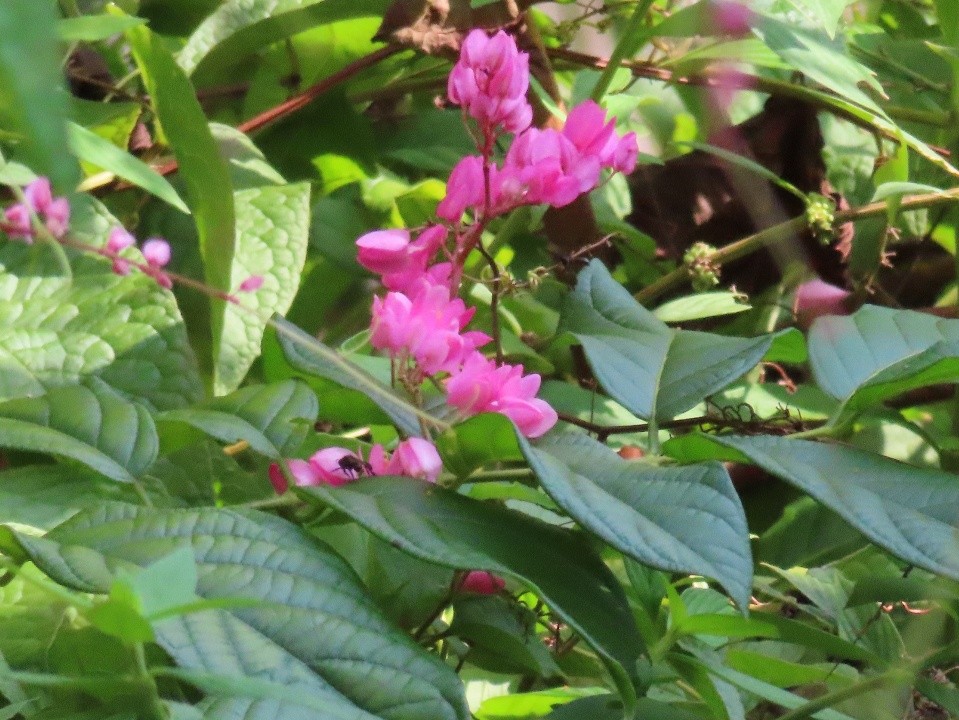
Stingless bees forage plants for food in the form of nectar (carbohydrate source), and pollen (protein source). Between these two, nectar- which is later transformed into honey, is more important as this is the energy source while pollen is more crucial for breeding.
In Malaysia where I live, local stingless bee honey is at least three times more expensive than honey from honey bees. This is mostly due to the limited volume of production. Despite its lower productivity, meliponiculture or stingless beekeeping has its advantage here because it does not sting, it is native, and there is a common belief that it offers more therapeutical benefits than other type of honeys. This belief is not just a marketing strategy. There is a recent finding that proves an abundance of trehalulose in the stingless bee honey (Fletcher et al., 2020), which is lower in glycaemic index. Although there is few studies linking the plant sources to honey quality, past research from the Neotropics have shown that the therapeutic quality of stingless bee honey is indeed influenced by the botanical origin of the nectar, as well the species of stingless bees producing them (Camou-Guerrero et al., 2020).
What first piqued my interest on stingless bees was the honey, which is very distinct from honey bees’ honey. It is sour, watery and after taking into consideration the cost, it is not my first choice of spread over a breakfast toast. I was told this distinct taste is owed to the stingless bees’ smaller size, enabling them to reach special reserve of nectar where the bigger bees could not. If this is true, which plant could it be?
I started compiling a list of bee plants two years ago as a reference to start my master’s research on stingless bee plant preference. I quickly became aware that stingless bees are considered polylectic, or generalist when it comes to plant preference, much like the honey bees. Perhaps I was a bit disappointed on this, as I expect to discover something…more unique. Bee plant list from books and open sources inclined towards honey bee forage. Useful reference for stingless bees usually came from the Neotropics. Upon further searches, I found that most studies on stingless bee plant foraging in the Southeast Asian countries are site-specific. I thought, I could really use a compiled dataset, but no one seems to have done this specifically for this region. This has led to our latest article- A Review of Stingless Bee Plant Sources in the Indo-Malayan Region.

In this review, we compiled stingless bee plant list from twenty-six studies in the Indo Malayan region. In terms of bee species, researchers seemed to incline towards the commercial stingless bee species, for example, the species of choice in Malaysia is Heterotrigona itama. We noticed that the top two plant families, Fabaceae and Asteraceae correspond to findings from other eco-regions (Bueno et al., 2023) but the subsequent or ‘secondary’ plant families of choice are different. We also did not expect Orchidaceae, the second most- specious plant family in this region to be less prominent. It is interesting to find that the most popular plant species does not come from the Fabaceae or Asteraceae family (clue: the flowers are clustered, which saves the stingless bees’ energy).
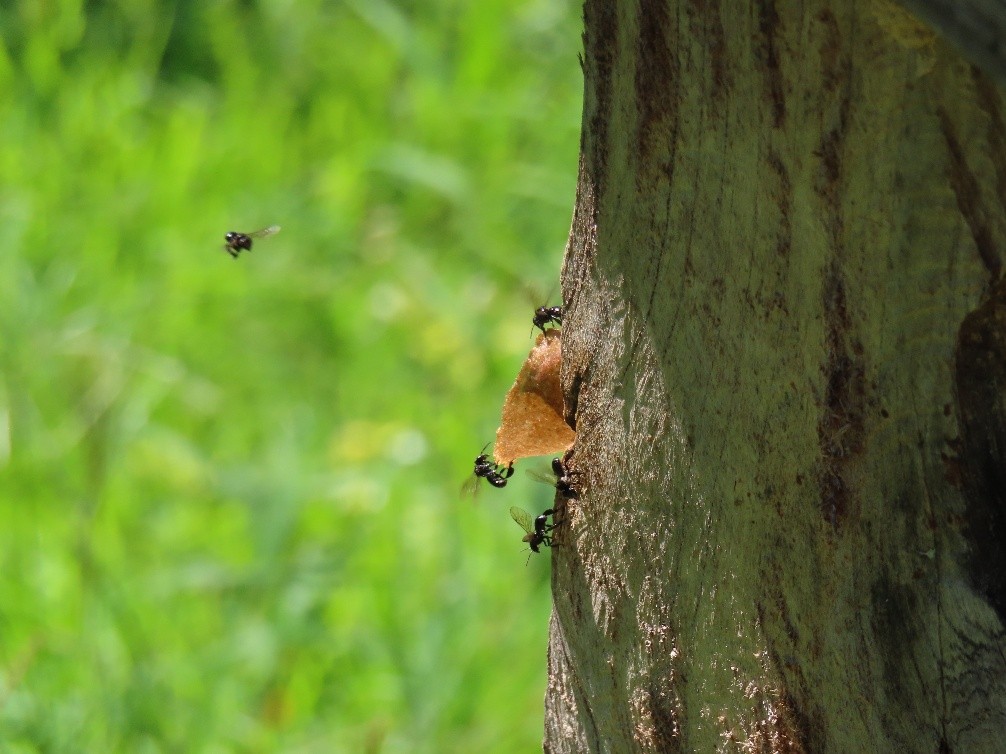
The result of our review reminds one to be prepared for the unpredictable nature of- well, the natural environment. For instance, the Antigonon leptopus did not appear in our top ten plant species list. Perhaps, many beekeepers, like the one I encountered, observed the same situation. It is more than probable that a polylectic bee can still be choosy when there are choices.
References
Alim, E., Yek, S.H. A review of stingless bee plant sources in the Indo-Malayan region. Insectes Sociaux (2025). https://doi.org/10.1007/s00040-025-01033-1
Bueno, F. G. B., Kendall, L., Alves, D. A., Tamara, M. L., Heard, T., Latty, T., & Gloag, R. (2023). Stingless bee floral visitation in the global tropics and subtropics. Global Ecology and Conservation, 43, e02454. https://doi.org/10.1016/j.gecco.2023.e02454
Camou-Guerrero, A., Reyes-González, A., Reyes Salas, O., Ramírez-Arriaga, E., Vicente Vega Peña, E., Martínez, J., Lucero Romero-Martínez, D., & Lilia Torres-Juárez, A. (2020). Pot-Pollen and Pot-Honey from Stingless Bees of the Alto Balsas, Michoacán, Mexico: Botanical and Physicochemical Characteristics. In V. De Alencar Arnaut De Toledo & E. Dechechi Chambó (Eds.), Honey Analysis—New Advances and Challenges. IntechOpen. https://doi.org/10.5772/intechopen.86927
Fletcher, M. T., Hungerford, N. L., Webber, D., Carpinelli de Jesus, M., Zhang, J., Stone, I. S. J., Blanchfield, J. T., & Zawawi, N. (2020). Stingless bee honey, a novel source of trehalulose: A biologically active disaccharide with health benefits. Scientific Reports, 10(1), 12128. https://doi.org/10.1038/s41598-020-68940-0
 insectessociaux