by Paige Caine
Paige Caine is a PhD student working in Dr. Michael Goodisman’s lab at Georgia Tech. She studies fire ants and yellowjacket wasps. In this blog, she explains how social insects, such as termites, ants, or bees, collectively manage to build complex nests. Her latest research on social insects can be read here.
A builder stands at the foot of her construction, a massive skyscraper towering thousands of times her height. The imposing architectural feat stretches stories underground as well, and is home to thousands of individuals. She can’t see the results of all her hard work though; she’s blind. In fact, the entire team of builders responsible for the structural triumph is blind, and they didn’t have a chief architect or any blueprints to guide them. How did they do it?
To answer this question, let’s meet the construction crew: Cathedral Termites. Native to Australia, this species of termites has blind workers measuring only about 3-4.5 millimeters long, yet they build massive nests to house their queens, kings, and young.
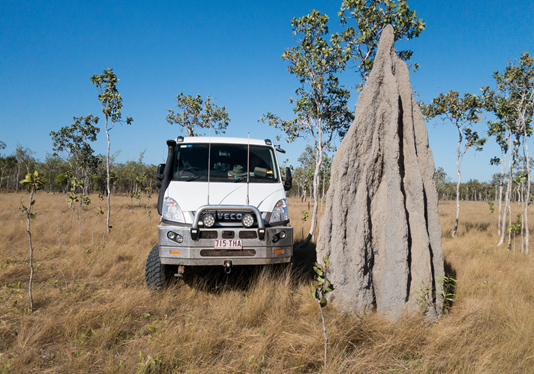
But this feat isn’t unique to Cathedral Termites—most social insects construct some form of nest. These structural marvels range in size and shape, from Cathedral Termite mounds to charismatic honeybee hives to tiny ant homes contained within acorns. In the absence of realtors, social insects often use collective decision-making to choose a nest location that optimizes temperature, sunlight, precipitation level, predation risk, and proximity to resources (Jeanne and Morgan 1992; London and Jeanne 2000; Suzuki et al. 2007). These strategies typically involve sending a few scouts to locate potential nesting sites. The scouts then recruit colony-mates to “vote” on sites by physically going to that site and contributing to the recruitment effort. Eventually, a quorum is reached, and the losing party packs up from their rejected sites and heads to the winning location (Pratt 2005).
Once the site has been chosen, a range of different construction methods are used to build the nest. Termites and ants tend to excavate their homes, while social bees and wasps tend to build their homes from manipulated biological material—chewed up wood pulp in the case of social wasps or wax in the case of some bees.

A common problem during collective construction—and one most human commuters are accustomed to—is crowding. To excavate a massive structure composed of tunnels and chambers, ants and termites must navigate narrow spaces containing hundreds or even thousands of individuals. One way termites solve this problem is through something referred to as a “bucket brigade;” like humans passing water towards a fire via a series of buckets, some termite species form a queue and pass excavated material along from individual to individual until it reaches the deposition site (Bardunias and Su 2010). Some ants, on the other hand, utilize “laziness” to avoid crowding, by having certain individuals sit still while a minority actually contributes significantly to construction (Aguilar et al. 2018).
But, if there’s no blueprint and no architect in charge of doling out specific tasks, how are all these individual construction behaviors coordinated?
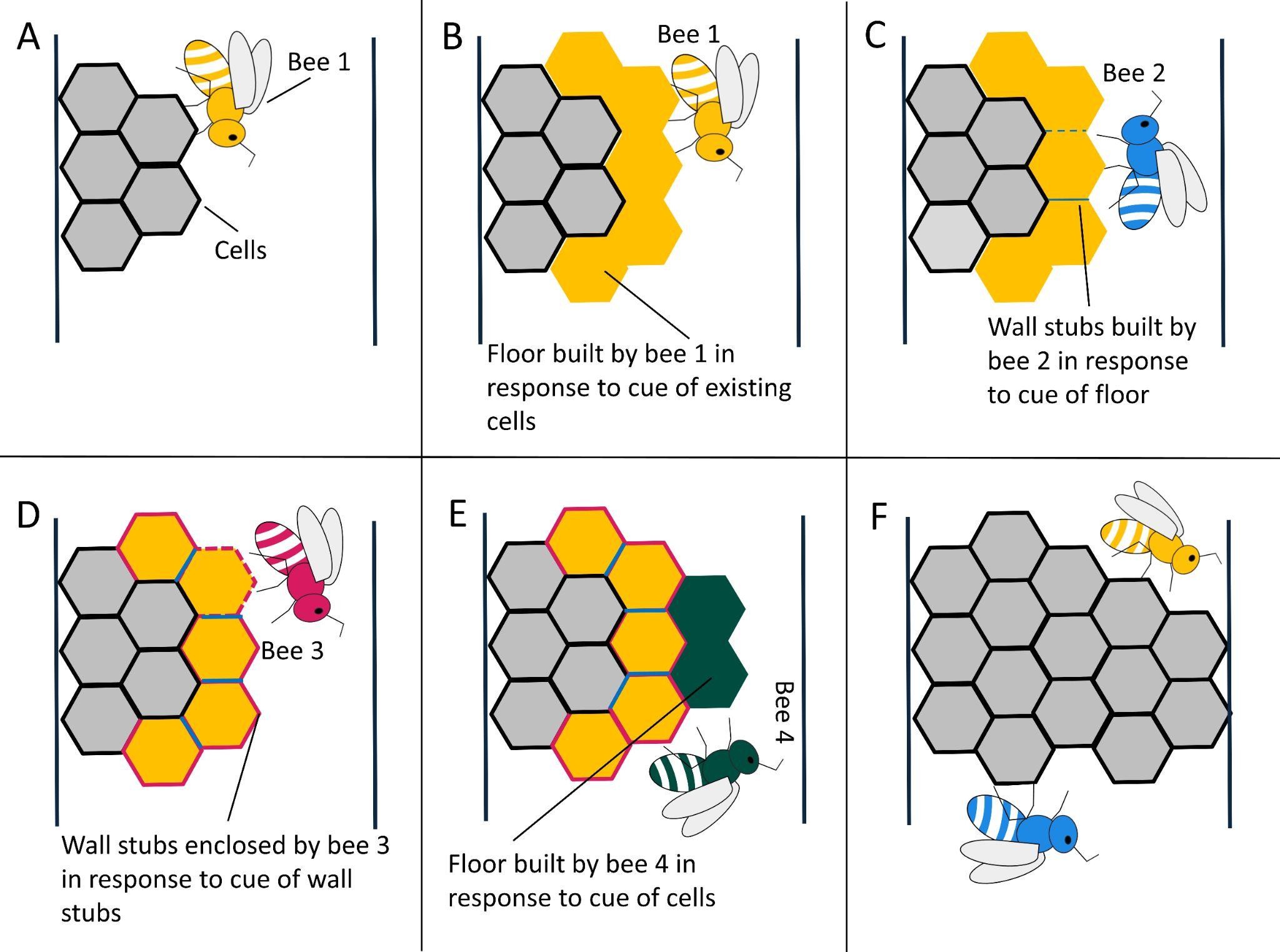
One common means of coordination is stigmergy, which means communicating across time via the environment. Each time an individual interacts with the incipient construction, they leave behind traces of their behavior, either by shaping the material or leaving behind chemicals. These cues tell individuals who later approach the construction what has been done, and what’s left to do.
Now that we know how social insects build their remarkable nests, another natural question is why?
Social insect nests offer many advantages to residents. For one, they offer protection from weather, much like a human home. They also protect against infection, with many species actively incorporating antimicrobial bacteria or other antibiotic agents into the walls (Tranter et al. 2013; Madden et al. 2013; Chouvenc et al. 2013). Nests also enable protection against larger threats, functioning as defendable fortresses. In fact, many species employ guards at nest entrances, and often close their doors at night (Bennett and Baudier 2021). Finally, nests help large insect societies organize their behaviors by physically contributing to division of labor, as well as by influencing the efficiency of collective tasks like foraging.

Overall, social insect nest construction is an impressive feat, and the results are both structurally remarkable and highly functional. One day, we may be able to imitate such techniques using swarm robotics. Today, many engineers are already working on bio-inspired robot collectives capable of construction. Robotic models are even being designed to test hypotheses about collective behaviors in social insect groups, an approach recently termed “robophysics.” In the future, robophysical models may unlock some of the principles underlying social insect nest construction, strengthening our understanding of collective behavior in both engineering and biology.

References:
Aguilar J, Monaenkova D, Linevich V, et al (2018) Collective clog control: Optimizing traffic flow in confined biological and robophysical excavation. Science 361:672–677. https://doi.org/10.1126/science.aan3891
Bardunias PM, Su NY (2010) Queue Size Determines the Width of Tunnels in the Formosan Subterranean Termite (Isoptera: Rhinotermitidae). J Insect Behav 23:189–204. https://doi.org/10.1007/s10905-010-9206-z
Bennett MM, Baudier KM (2021) The Night Shift: Nest Closure and Guarding Behaviors in the Stingless Bee, Tetragonisca angustula. J Insect Behav 34:162–172. https://doi.org/10.1007/s10905-021-09779-9
Caine, P.B., Robertson, A.T., Treers, L.K. et al. Architecture of the insect society: comparative analysis of collective construction and social function of nests. Insect. Soc. (2025). https://doi.org/10.1007/s00040-025-01057-7
Chouvenc T, Efstathion CA, Elliott ML, Su N-Y (2013) Extended disease resistance emerging from the faecal nest of a subterranean termite. Proceedings of the Royal Society B: Biological Sciences 280:20131885. https://doi.org/10.1098/rspb.2013.1885
Jeanne RL, Morgan RC (1992) The influence of temperature on nest site choice and reproductive strategy in a temperate zone Polistes wasp. Ecological Entomology 17:135–141. https://doi.org/10.1111/j.1365-2311.1992.tb01170.x
London KB, Jeanne RL (2000) The interaction between mode of colony founding, nest architecture and ant defense in polistine wasps. Ethology Ecology & Evolution https://doi.org/10.1080/03949370.2000.9728440
Madden AA, Grassetti A, Soriano J-AN, Starks PT (2013) Actinomycetes with Antimicrobial Activity Isolated from Paper Wasp (Hymenoptera: Vespidae: Polistinae) Nests. Environ Entomol 42:703–710. https://doi.org/10.1603/EN12159
Nazzi F (2016) The hexagonal shape of the honeycomb cells depends on the construction behavior of bees. Sci Rep 6:28341. https://doi.org/10.1038/srep28341
Pratt SC (2005) Quorum sensing by encounter rates in the ant Temnothorax albipennis. Behav Ecol 16:488–496. https://doi.org/10.1093/beheco/ari020
Suzuki Y, Kawaguchi LG, Toquenaga Y (2007) Estimating nest locations of bumblebee Bombus ardens from flower quality and distribution. Ecol Res 22:220–227. https://doi.org/10.1007/s11284-006-0010-3
Tranter C, Graystock P, Shaw C, et al (2013) Sanitizing the fortress: protection of ant brood and nest material by worker antibiotics | Behavioral Ecology and Sociobiology. Behavioral Ecology and Sociobiology 68:499–507. https://doi.org/10.1007/s00265-013-1664-9
 insectessociaux