By Daniela Torres Garcia
In this blog, Daniela Torres Garcia, from the University of São Paulo, describe how she discovered that the number of females in a Mischocyttarus cerberus wasp nest influences the departure of males for mating. This latest research on social insects can be read here.
In social hymenopterans, male reproductive success depends entirely on the timing of reproduction, as males play no role in maintaining the colony—at least in the widely studied species. Males of many species, including social wasps, undergo post-pupal sexual maturation within the natal nest before dispersing to mate, during which time they rely on their nestmates for protection and food.
This leads us to a key question: do all males leave the nest at the same time, or is there something that makes some of them stay longer or shorter in their natal nest?
To answer this, we observed a population in southeastern Brazil of the Neotropical species Mischocyttarus cerberus. We conducted a rigorous monitoring of the nests of this species over several weeks to track male dispersal, and we found that the time a male spends in the nest before leaving varies. Some males leave the day after emerging, while others remain for almost a week.

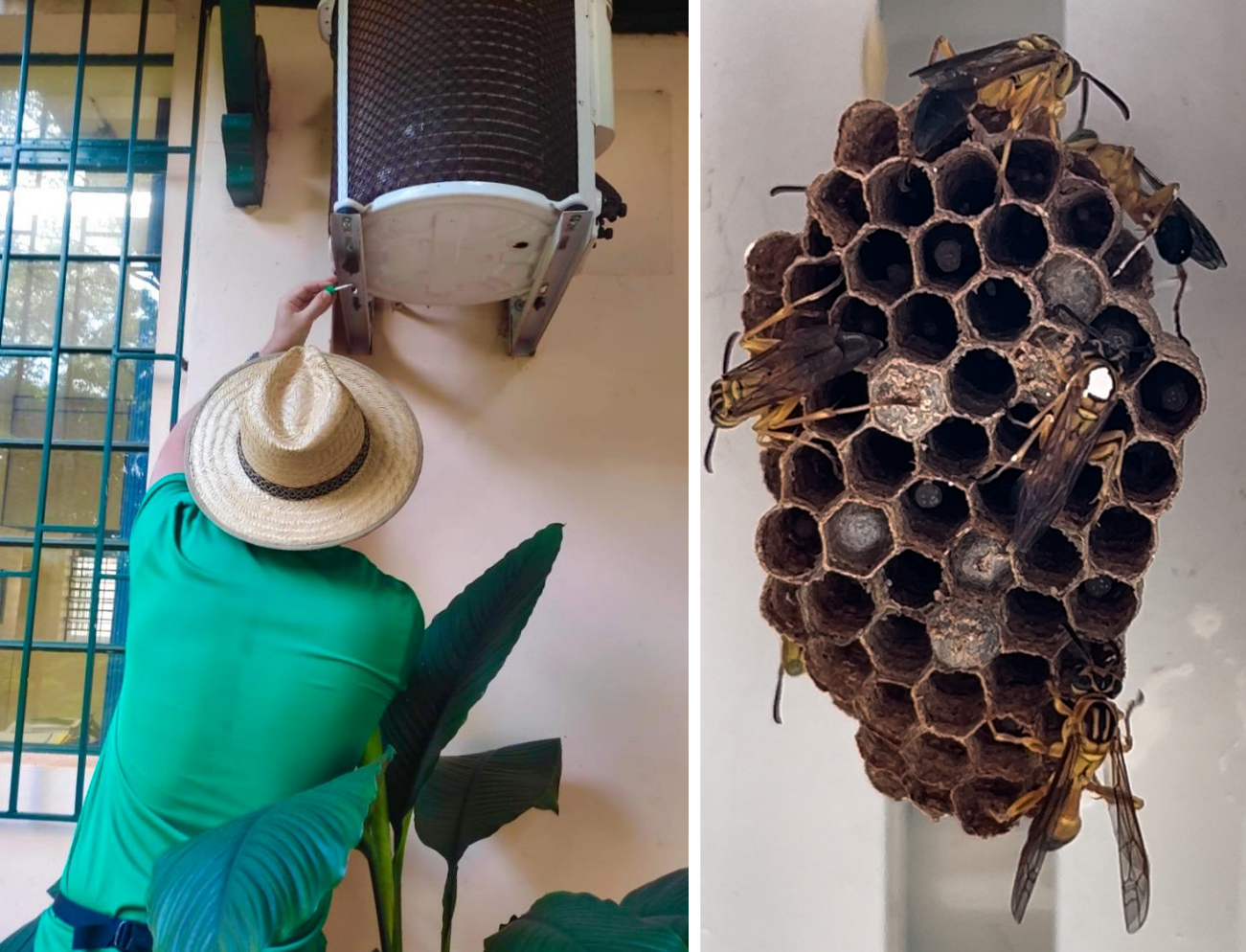
Nest of M. cerberus with females and males. Photo by Andres Rodrigues De Souza.
Given this variability, we asked what factors might be influencing male dispersal timing. Does the social context affect this variability? That is, does the number of adult females in the nest influence how long the males stay? Do males stay longer when more adult females are present?
We addressed these questions using two approaches: on the one hand, observationally, by monitoring 36 natural nests; on the other hand, experimentally, by manipulating the number of females in 22 nests to see whether this caused a change in male dispersal behavior. And what did we find? Males in nests with more females stayed longer, thereby delaying their dispersal.
On average, males left after 3 days, but some took up to 8 days. We found that in nests with three females, males stayed for about 2.8 days, whereas in nests with only one female, they left after just 1.7 days. This suggests that females modulate male dispersal, which can last up to 8 days—similar to another social wasp, Polistes lanio (up to 7 days) (Southon et al., 2020). Why? Probably because staying in the nest is safer and more comfortable. More females mean better defense against predators and more food available. It is worth remembering that the sting—the primary defense mechanism of this group—is associated with the female reproductive system and thus is absent in males.

Therefore, it is not surprising that males from nests with more females delay their dispersal to complete their sexual maturation in a safer and more comfortable environment, thereby increasing their survival and future reproductive competitiveness (i.e., by accumulating energy reserves). The accumulation of these reserves could help them avoid having to expose themselves on flowers to obtain food once dispersed.
Taken together, these results highlight the role of social context in shaping male reproductive strategies and suggest that pre-dispersal social life may be an underestimated factor in the physical fitness of males in social insects.
The reproductive biology of male social insects has often been studied at mating sites, such as leks and swarms (Beani et al., 1992; Beani et al., 2014). However, less attention has been given to male behavior prior to reaching these sites (e.g., Southon et al., 2020), despite its potential to influence male competitive ability. Therefore, pre-dispersal social life may be an overlooked aspect of male paper wasps’ reproductive strategies.
References
Beani L, Dessì-Fulgheri F, Cappa F, Toth A (2014) The trap of sex in social insects: from the female to the male perspective. Neurosci Biobehav Rev 46:519–533. https://doi.org/10.1016/j.neubiorev.2014.09.014
Beani L, Cervo R, Lorenzi CM, Turillazzi S (1992) Landmark-based mating systems in four Polistes species (Hymenoptera: Vespidae). J Kansas Entomol Soc 8:211–217 https://www.jstor.org/stable/25085358
Garcia, D. T., Santos, E. F., Santos, S. A., do Nascimento, F. S., Krams, I., Rantala, M. J., & de Souza, A. R. (2025). Social context predicts male dispersal in nests of a paper wasp. Insectes Sociaux, 1-4. https://doi.org/10.1007/s00040-025-01050-0
Southon, R. J., Radford, A. N., & Sumner, S. (2020). Hormone-mediated dispersal and sexual maturation in males of the social paper wasp Polistes lanio. Journal of Experimental Biology, 223(23), jeb226472.
 insectessociaux