By Luisa M. Jaimes-Nino
Luisa is a researcher at Johannes Gutenberg University Mainz. She specializes in studying the life-history traits of ants, their senescence, and the genetic and non-genetic mechanisms influencing queen fitness. Read her latest article in Insectes Sociaux here.
Queens, and kings in termites, are highly fertile and long lived insects. But certainly there is variation to which extent they are fertile. We were intrigued to understand what causes variation in fitness traits?
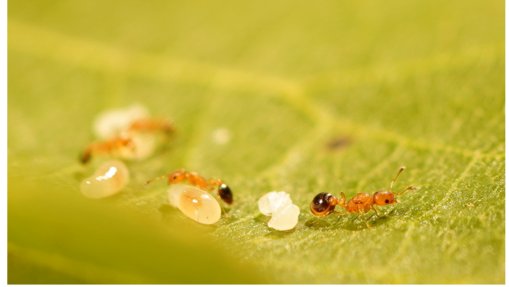
We wondered if very fertile queens were also more successful by producing very fertile daughters. Is this caused by a genetic factor or perhaps the maternal status, such as maternal age? Old mothers might produce less fit queens and workers, and this can have a detrimental effect for the future of the whole colony. The negative effect of parental age, known as Lansing effect, has been documented across a wide range of taxa but not yet investigated in social insects.
We used Cardiocondyla obscurior ants as model given their high variability in fertility and longevity. We investigated how fertility varies by selecting mothers that produced a low and high number of eggs after 15 weeks. We profited from a study in which we monitored a batch of queens in controlled conditions for their entire life (Jaimes-Nino et al., 2022), and monitored their daugthers too, to test if they presented a similar fertility and longevity.

Our model species is polygynous, meaning that a large number of queens cohabit within a single colony. However, it is known that those queens that live longer, produce also more eggs (Kramer et al., 2015) and more queen daugthers (Jaimes-Nino et al., 2022). Previous studies have shown that queens remain heathly for a long portion of their lives because their mortality rate and gene expression pattern remain stable until old age (Harrison et al., 2021; Jaimes-Nino et al., 2022). Therefore, it is important to test whether old queens produce daugthers that are equally fit compared to those of younger queens, given that they produce the majority of them within the colony!

Our results showed that mothers and daugthers do not “look” alike — they do not have a similar fertility or longevity. This could indicate that their genetic background does not account for the observed variation. This can be expected from C. obscurior, as it exhibits extreme inbreeding.
Furthermore, contrary to the Lansing effect reported in other taxa, we found that daugthers produced by old mothers were just as fit as those produced by young mothers. This aligns with the hypothesis that, since the majority of sexuals are produced later in life, there must be mechanisms in place to maintain the health of these queens as they age! We believe that selection against aging remains strong in older queens. The specific mechanisms by which C. obscurior queens are able to produce equally fit daugthers at such advanced ages awaits further investigation.

Strikingly, the maternal lines differed in productivity suggesting background variation influenced by the maternal environment or male quality. In this species, ergatoid males (worker-like males) figth against rivals to monopolize queen access. Our study offers new avenues of research, to disentangle the effect of mother, father and developmental environment, on the final reproductive success of queens.
References
Harrison, M.C., Jaimes Niño, L.M., Rodrigues, M.A., Ryll, J., Flatt, T., Oettler, J., et al. 2021. Gene Coexpression Network reveals highly conserved, well-regulated anti-ageing mechanisms in old ant queens. Genome Biology and Evolution 13: 1–13. https://doi.org/10.1093/gbe/evab093
Jaimes-Nino, L.M., Heinze, J. & Oettler, J. 2022. Late-life fitness gains and reproductive death in Cardiocondyla obscurior ants. eLife 11: 1–17. https://doi.org/10.7554/eLife.74695
Kramer, B.H., Schrempf, A., Scheuerlein, A. & Heinze, J. 2015. Ant colonies do not trade-off reproduction against maintenance. PLoS ONE 10: 1–13. https://doi.org/10.1371/journal.pone.0137969
 insectessociaux