Maria is a Brazilian PhD student at the Universidade de São Paulo, currently in her final year. Her research focuses on the foraging strategies of ants. Alongside her work, she is also deeply interested in data analysis and scientific communication. Her latest work in Insectes Sociaux can be found here.
IS: Who are you and what do you do?
I’m a Brazilian PhD student studying ants’ behavioural characteristics at the Universidade de São Paulo. I’m specifically using solitary foraging ants to understand how internal, social, and environmental factors impact foraging execution and performance.
IS: How did you develop an interest in your research?
My interest emerged quite early, while I was in the first year of my biological sciences degree. During the entomology course, I was especially interested in the Hymenoptera group, but knowing their names and morphological characteristics did not seem enough for me. Shortly afterwards, I met Professor Arrilton and joined his laboratory, where I was able to access the ethological approach to ants’ biology. Since then, I have been working on and maintaining my passion for this topic.
IS: What is your favorite social insect, and why?
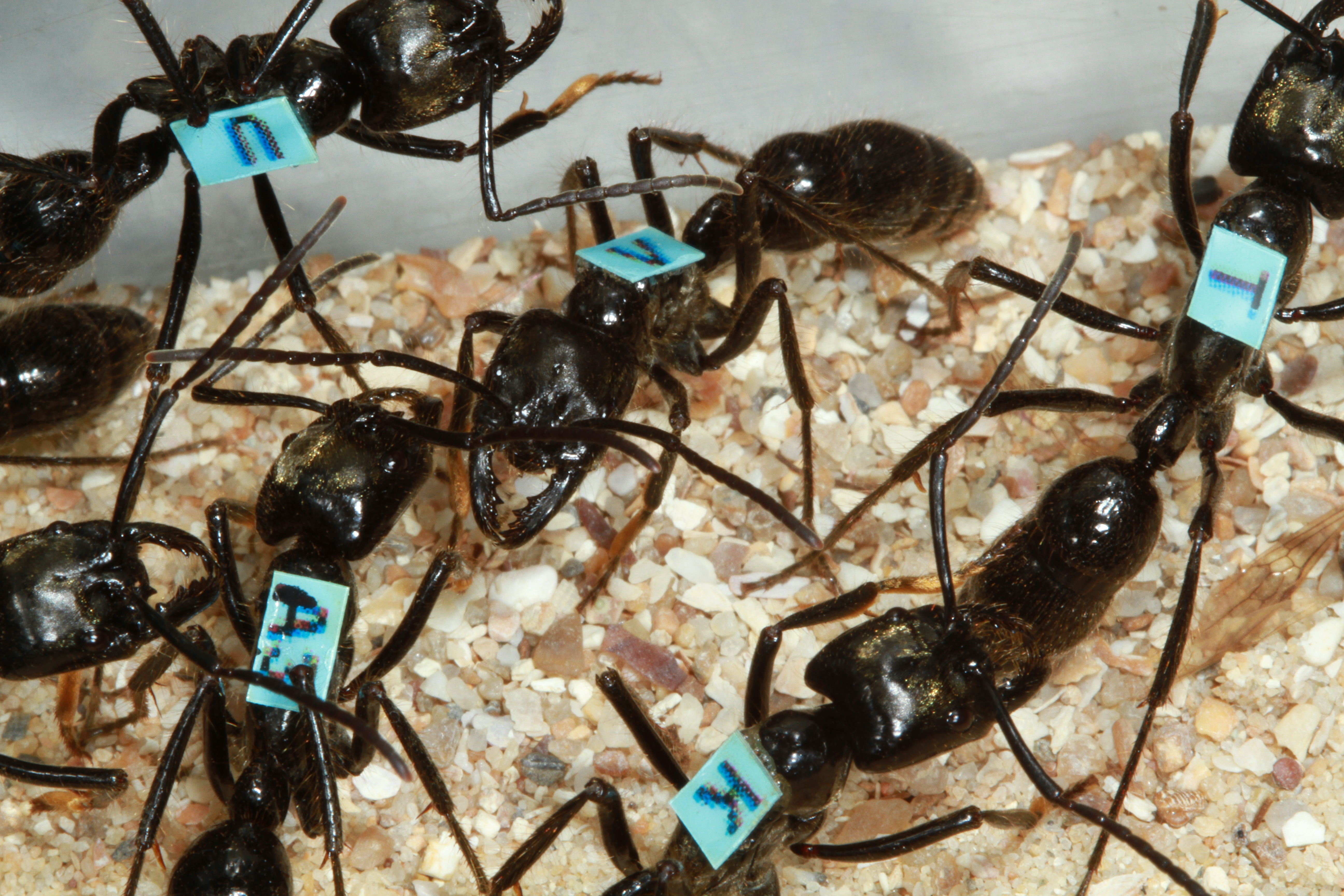
I have to choose the ants of the genus Dinoponera, and if I had to be more specific, the giant ant Dinoponera quadriceps. This is because it’s the first ant I’ve worked on, and it’s certainly an ant that causes a ‘wow factor’. I find them very pretty, and the ecological role they play is even more beautiful. Unfortunately, factors in their biology make them sensitive to anthropogenic activity, and I fear that future generations will not be able to experience the same enchantment to see one of these ants alive.
IS: What is the best moment/discovery in your research so far? What made it so memorable?
I always have my best time doing fieldwork with my lab colleagues or when I have the opportunity to speak about ants to the public. It’s a pleasure to attend scientific events, but also to visit schools and make science communication live to a younger audience. My most memorable discovery so far was the fact that D. quadriceps foragers don’t aggressively compete with their neighbours. I read some anecdotes about these ants being very territorial and aggressive, but over many months of observation during my master’s, I realised that they are ‘gentle giants’ and that this type of interaction was quite rare.
IS: Do you teach or do outreach/science communication? How do you incorporate your research into these areas?
I always tried to dedicate myself as much as possible to science communication. Passing on my knowledge has been one of my career goals. Since in Brazil we researchers are formed in public institutions, I think we must increase our contact with society. I’ve spoken to public school students about the importance of ants, and today I lead a podcast (unfortunately only available in Portuguese for now) called ‘Atiçando o formigueiro’. The podcast is an initiative that aims to inform people about the biology and importance of our country’s native ants and social insects. In addition, we also seek to increase the visibility of Brazilian myrmecologists working in different fields. In the next few years, increasing my teaching experience will be one of my priorities, and I hope to have the opportunity to work professionally in this area.
IS: What do you think are some of the important current questions in social insect research, and what is essential for future research?
Considering the climate crisis scenario in which we live, I believe that the least we researchers can do is to look into the current and imminent effects that irreversible climate change is having on social insects and, indirectly, on the rest of the planet. It is not possible to defend the preservation of species and habitats without first providing reliable data on what is happening and what will happen in the coming years to the insects we know.
IS: Outside of science, what are your favorite activities, hobbies, or sports?
My favourite hobby is playing video games, especially RPGs or simulation games on my PC, or board games. I also like going to the cinema and watching reality TV shows of dubious taste. Of course, I spend a good part of my day listening to podcasts from genres ranging from talk shows to true crime. I also walk and look after my dog, Nala. I don’t like playing or watching sports at all and I feel completely oblivious to the subject.
IS: What is the last book you read? Would you recommend it? Why or why not?
The last book I read was actually a comic book called Ordinary Victories by Manu Larcenet. Manu Larcenet is a well-known French cartoonist. I would recommend Ordinary Victories and his other works.
IS: How do you keep going when things get tough?
Unfortunately, this type of situation is not rare in academia. When this happens, I try to focus on other things (such as my family or hobbies) to then return with a clear mind. I always seek the support of the people around me and try to be kind to myself, set reasonable goals, and work within specific deadlines and expectations. For me, being open about going through a difficult time also helped make communication with my peers more accurate and honest.
IS: If you were to go live on an uninhabited island and could only bring three things, what would you bring? Why?
I’d bring a blanket, food supplies, and my dog. A blanket because I’m always cold, even when it is 25 ºC. Food supplies because even if the island contains animals to catch or fruit to collect, I’m not sure I have the ability to find them and survive on my own. Of course, I would bring my dog because I need some social interaction and a friend.
IS: Who do you think has had the most considerable influence on your science career?
It’s difficult to answer because I’ve always been surrounded by incredible people who taught me everything I know and believed in me at all times. I’d say Arrilton Araújo, Dina Azevedo and, of course, my PhD mentor Nicolas Châline. Arrilton and Dina, because they gave me a very solid foundation for being a social insect scientist, encouraged me to create interest and dedication to all stages of the research and always treat people with kindness. Nicolas for all his brilliant ideas and motivation to pursue and execute them even if the plan does not go as expected, thinking beyond and making hypotheses about everything around us. They are all great ethologists who are a reference for all the work I do and continue to be my greatest sources of inspiration.

IS: What advice would you give to someone hoping to be a social insect researcher in the future?
I’d say: Do it! It’s a brilliant area with many collaborative researchers and, most importantly, many interesting questions to be answered. I would recommend getting to know your insect, observing it ad libitum, spending some time getting familiar with it, and then starting to think about questions, especially more complex ones. I would recommend trying to find these missing pieces in the puzzle before trying to create a big picture to avoid broad generalizations and frustration.
IS: Has learning from a mistake ever led you to success?
It always does. I believe we learn a lot from our mistakes, and experimentation is all about trying and failing multiple times. Failing allows us to remain humble and realize that there is no such thing as perfection. It allows us to seek different opinions and guidance and also not give up. In this sense, my advice is to plan a pilot testing period and allow yourself to make mistakes. Also, expect that mistakes and simply unpredictable things can and will happen along the way.
IS: What is your favorite place science has taken you?
Science allowed me to live in Paris for 6 months and completely change my research environment to another country (and continent!) where I was able to learn a lot about research, but also about the local culture.

 insectessociaux