Lachlan Jones is an ecologist and entomologist working in England. He investigates bumblebee disease spread and the potential for natural chemicals in heather nectar to protect bees. His latest work in Insectes Sociaux can be found here.
IS: Who are you, and what do you do?
I’m an ecologist/entomologist from Australia, though currently working in England. At the moment my work is about bumblebee disease spread and the potential for natural chemicals found in heather nectar to act a preventative medicine protecting bees from infection by the gut parasite Crithidia bombi. My work has been varied and has previously involved polyethism in stingless bees in Australia, influence of climate on body size of solitary bees in the Rocky Mountains, USA, ecology and behaviour of host plant recognition in generalist pest moths, parental care and group size in jewel bugs, responses of thrips to weather conditions and the use of aquatic weevils as bio-control agents.
IS: How did you develop an interest in your research?
I was always fascinated by science and geography growing up, and had parents who took me on plenty of walks in national parks and various other outdoor activities. I also had several great teachers in high school who further contributed toward my enthusiasm for science. I didn’t fully decide until towards the end of my undergraduate studies that ecology, rather than chemistry or genetics say, was definitely the path for me, but I certainly think I made the right decision. I got into social insects specifically when finishing my PhD when I got involved in a side project about stingless bees with James Hereward, a postdoc in the Walter Lab where I did my PhD. This project eventually led to the paper that I’ve just published in Insectes Sociaux. I think the fact that I was willing to study stingless bees purely as a volunteer also helped when applying for a Fulbright to study bees and climate change in the US, which in turn led me to my current position studying bumblebee health.
IS: What is your favorite social insect, and why?
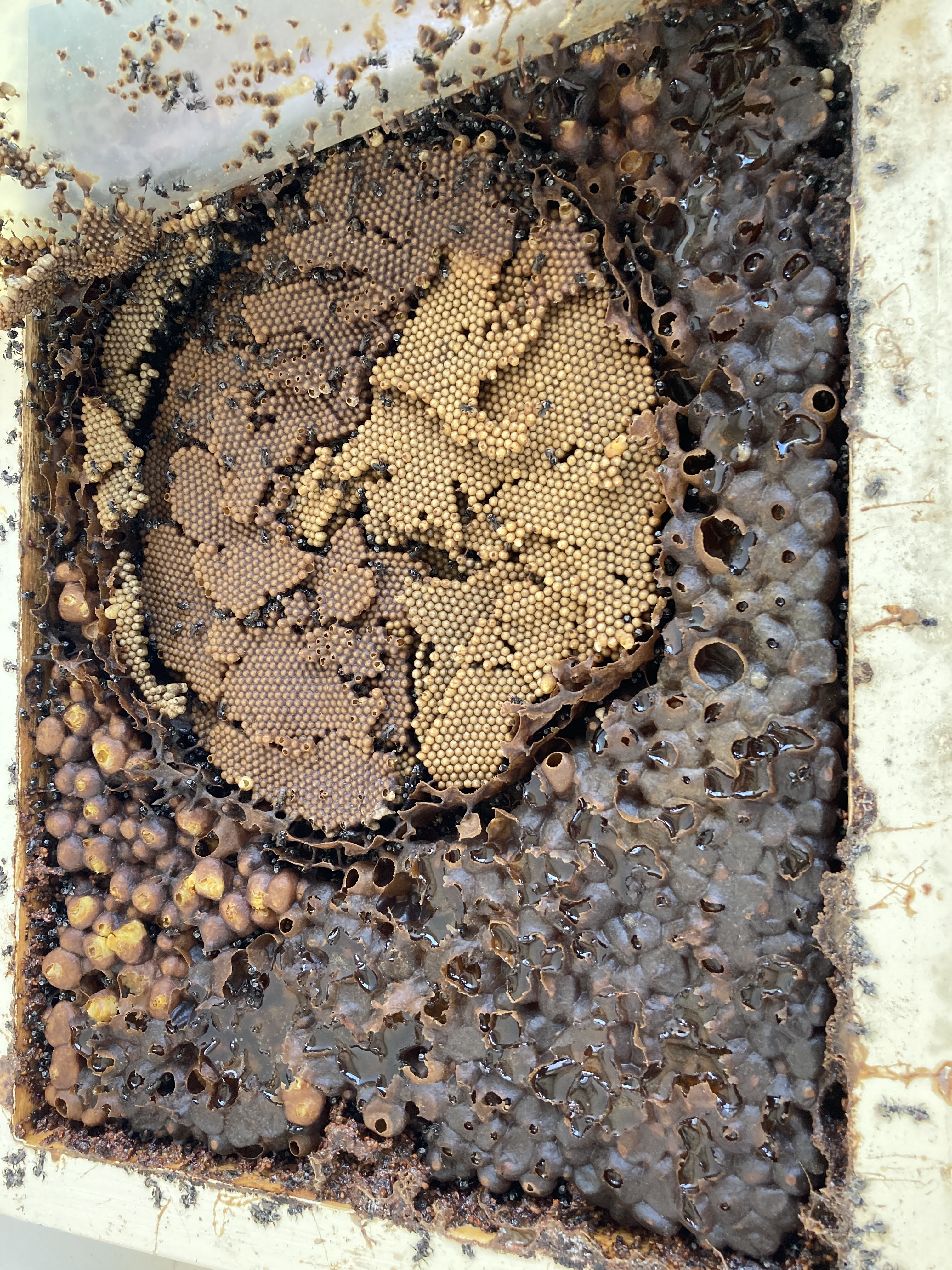
I think if I’m to pick one it would have to be Tetragonula carbonaria. These are one of the most familiar species of native bees in and around my home city of Brisbane, build their brood comb within the nest in a beautiful spiral structure, and (along with their congener T. hockingsi) perform a wide variety of interesting nest-maintenance behaviours I had the chance to study in one of the most fun projects I’ve worked on.
IS: What is the best moment/discovery in your research so far?
What made it so memorable? It was probably the time, about six weeks into my Honours, when there was a heavy downpour one morning like I’d been waiting for. I seized my insect traps and metal poles, ran out to the Malvaviscus bush I’d been using as a field site and threw the traps up. When I looked at the traps later, I counted more thrips on the traps than I’d captured on some previous sunny days. It showed immediately that thrips do indeed fly when it’s raining, even in a heavy downpour, which was certainly not what I or my supervisor had been expecting!
IS: Do you teach or do outreach/science communication?
How do you incorprate your research into these areas? I don’t currently teach, although I have previously given tutorials. As for outreach, I ran a couple of sessions on bees and pollination at a children’s nature camp last year which was fun. And, quite by accident, when collecting bumblebee queens in Windsor Great Park earlier this year to establish experimental colonies, I ended up having a lot of conversations with interested passers-by about bumblebee disease, threats and what I was trying to do about it.
IS: What do you think are some of the important current questions in social insect research, and what is essential for future research?
One significant and central question is how and why social insects evolved such a life cycle. While progress has been made, this question is complex to answer and is multifaceted, encompassing what selection pressures, novel adaptations and pre-adaptations led firstly to primitively social constructs like those commonly found among sweat bees (Halictidae) today, and then from there onto the fully eusocial colonies seen among honeybees, stingless bees, ants and termites. A related question is what leads social behavior to be lost, such as in the orchid bees.
Coming from the perspective of stingless bees, another important question is communication of foraging information within the colony. Experimental studies using placement of artificial feeders have shown that a stingless bee forager is capable of communicating to recruit other foragers to a nectar source, but how they do this, and whether it bears any similarities to the waggle dance of honey bees, is unknown.
A lot of great work is also being done on answering some fascinating questions relating to social immunity. Large insect colonies densely packed with genetically identical individuals provide ripe ground for rapid disease spread, and there are numerous surprisingly ‘clever’ strategies insects have evolved to isolate infected individuals and minimize contact between workers in different parts of the colony. While further innovations in genetics/genomics and neuroscience will likely make strides towards understanding many fundamental questions in social insect biology, I also think it is important to remember the value of patient observation and well-designed behavioral experiments that have allowed us to have such a detailed understanding of communication in honeybee colonies.

IS: Outside of science, what are your favorite activities, hobbies, or sports?
Reading novels, particularly fantasy, historical fiction and crime/legal thrillers; hiking (or bushwalking as we call it Down Under) and playing guitar are my biggest hobbies.
IS: What is the last book you read? Would you recommend it? Why or why not?
It was a novel called The Glovemaker’s Daughter – set in 17th century Yorkshire and the American colonies and about Quakers. I thought it was an interesting story that told me a lot I didn’t know about that period, a good read if you like history.
IS: How do you keep going when things get tough?
I try to remind myself that I am indeed lucky to be able to follow my interests and discover new things about the natural world as a job, and that my most successful projects had quite a few frustrating failures at the beginning.
IS: If you were to go live on an uninhabited island and could only bring three things, what would you bring? Why?
Probably a book on the local flora and fauna, both so I could make natural history observations to pass the time, but also have an idea of what might be edible; materials to make a fire, and a dinghy, both for exploring around the island’s perimeter and so I could escape if life there got too tough.
IS: Who do you think has had the most considerable influence on your science career?
I think that would have to be Professor Gimme Walter, who I initially had as a lecturer and later was my Honours and then PhD supervisor. I think he struck a good balance between guiding me in the right direction while still giving me freedom to try things, and I have many fond memories of afternoon lab discussions on his back deck about all sorts of broad concepts and ideas in ecology and evolution and the assumptions behind them.
IS: What advice would you give to someone hoping to be a social insect researcher in the future?
I think I would simply say to go ahead with what questions interest you the most, though also remind them that recent discoveries have revealed social insects are scattered widely across the insect orders, with species of beetles, true bugs, thrips, cockroaches and shrimp now been shown to have social colonies, and that galling species in particular can have quite complex levels of sociality. So there is a lot of untapped potential for work beyond the organisms we usually think of as social insects such as ants, termites, bees and wasps.
IS: Has learning from a mistake ever led you to success?
About eight months into my PhD I decided I no longer wanted to continue with the initial plan looking at chemical ecology of host plant attraction, and instead focus on behaviour. While my supervisor was fine with me making the switch, and gave me the freedom to come up with my own ideas about what to do instead, I initially made the mistake of latching on to several unrelated experimental ideas I thought were interesting without thinking about what broader question the thesis as a whole should answer. At my PhD confirmation meeting, I was not initially confirmed as a PhD candidate but instead given 3 months to plan out what a cohesive thesis plan should look like. While it was tough going back to square one a year into my PhD, it meant I had a year of experience working, reading about and thinking about my study species to draw on when thinking about what the most important questions were that I wanted to answer. And consequently, the ideas I came back with and developed into a thesis were I think much better ideas than I could have come up with at the beginning.
IS: What is your favorite place science has taken you?
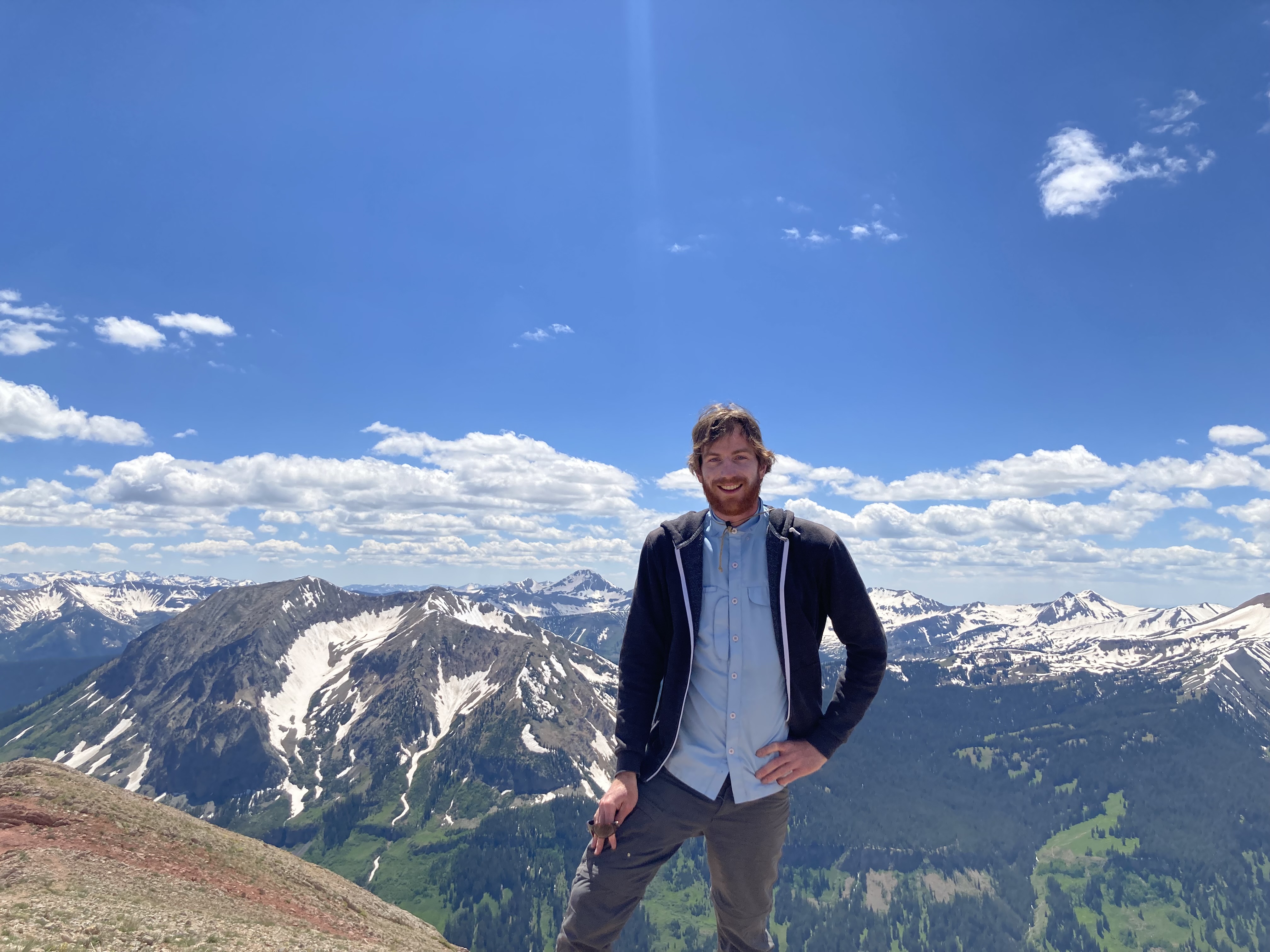
That would be the Rocky Mountain Biological Laboratory. An amazing place, it’s a research station at 3000m elevation in a stunning part of the Colorado Rocky Mountains. I had the good fortune of being able to work there last summer as a Fulbright scholar in Rebecca Irwin’s lab (North Carolina State University), and the field work in picturesque wildflower meadows surrounded by snow-capped mountains, weekend hikes with the numerous friends I made there and the incredible range of social activities at the station made it a truly unforgettable experience. The xperience I gained netting and identifying bumblebees as well as performing pollination experiments on wildflowers probably gave me the necessary experience to land my current postdoc at Royal Holloway University.
 insectessociaux
Great to see you Lachlan. We always knew you’d do well. Smithy and L x
LikeLike